

40 enterprise AI use cases from real companies in 2026

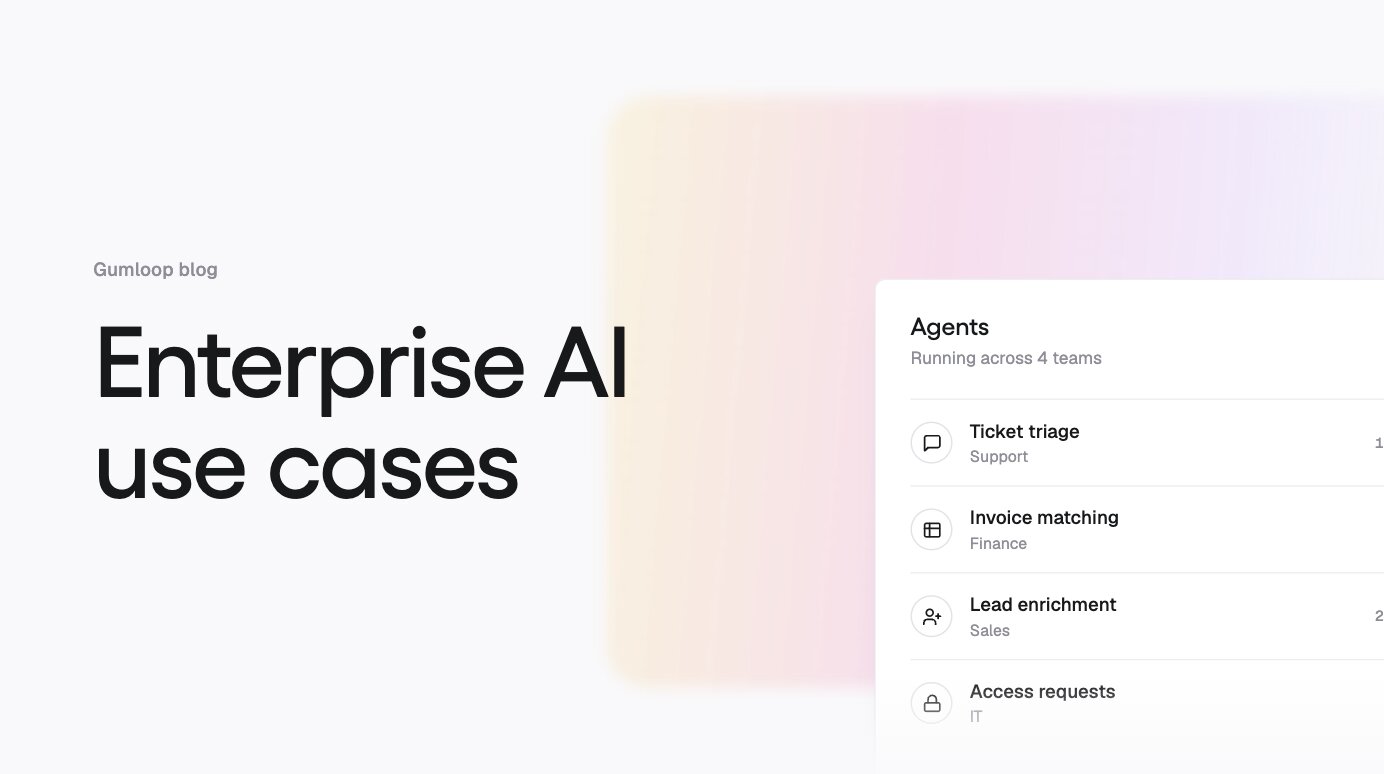
Here’s how real enterprise companies like Gusto, Samsara, and Instacart make AI work for them.
Artificial intelligence can empower enterprises to do work at a scale and speed that would have previously been impossible. With potential applications across nearly every industry, and every role and function you can think of, it can be difficult to know where to begin.
What are enterprise AI agents?
AI agents are software programs that use artificial intelligence to autonomously execute complex, multi-step plans. You can equip them with external tools and reusable instructions called skills to make sure that they follow specific tasks exactly the way that you want them to. They can also exist inside governance frameworks so they only ever operate within the guardrails set by your organization.
Every team within an enterprise organization can find ways to use AI agents, from GTM functions like sales, marketing, and customer success, to administrative functions like finance, HR, and legal.
How can enterprises start using AI agents?
At Gumloop, we regularly see enterprises successfully go from merely AI-curious to fully AI-native. Here’s some of the tips we have for making sure that enterprise AI use cases are actually successful:
- Start small: large enterprise companies have complex processes in place, and usually for good reasons. It’s unrealistic to expect everything to change overnight. Identify repetitive steps in existing processes and automate those first; you can always expand later.
- Let your experts do the building: subject matter experts understand what high-quality work looks like for their area of expertise. If your experts can create and refine the AI agents themselves, then you can scale their knowledge to the entire enterprise.
- Embed AI agents where your team already works: AI adoption is most effective when you make it as easy as possible for everyone in your org to use agents. If you can bring AI agents to the tools your team already uses (whether that’s Slack, Teams, email, or any other app), you dramatically increase the odds that people will actually use it.
Here are 40 example use cases of how our enterprise customers, like Gusto, Samsara, and Instacart, have applied artificial intelligence to solve their real business problems. We’ve organized them by role below: take a look.
Sales use cases
Rather than trying to sell on your reps’ behalf, the most effective sales use cases for enterprise AI agents address the research, admin, and operational tasks associated with each deal. That way, your reps can spend more of their time actually talking to customers.
1. Meeting prep and pre-call research
Automatically set up an agent to send your account executives structured intelligence briefings 30 minutes before every call. Your reps will always know who the people on the call are, what company they’re from, your org’s history with this company from your CRM, and their company’s tech stack. You can even prepare reps with talking points uniquely framed for the callers’ likely objections.
2. Post-call CRM updates
An AI agent can also automatically ingest call transcripts (by connecting to Gong, Google Meet, Zoom, or whichever tools your team uses) and automatically fill out MEDDPICC fields and next steps in your CRM. Your reps will never have to hand-log after a call ever again. You can even have your agent immediately draft a follow-up email after a call to ensure deals never get dropped.
3. Outbound prospecting and personalized sequences
An AI-powered outbound builder agent writes brand-compliant cold-email and LinkedIn sequences, with paced send timing. The agent performs web research to ensure that the content is relevant to the prospect, and adapts its tone to follow the organization’s brand and tone guidelines.
4. Lead nurture and reengagement
Don’t let your closed-lost leads and qualified signups go cold. A lead nurture agent can regularly check in with leads by sending re-engagement emails, using lead scoring to prioritize outreach in response to relevant market trends, news, or events.
Revenue Operations use cases
Revenue operations is the infrastructure layer that keeps the whole revenue engine working smoothly. RevOps use cases are particularly suited to workflow automation since they’re often driven by triggers (e.g., a new demo request coming in), run constantly in the background, and operate at scale. Agents work in the background while human team members focus on tasks that require human touch and judgment.
5. Lead qualification, routing, and enrichment
Ensure leads never fall through the cracks and always have the correct context. An AI agent watches inbound demo requests, enriches leads’ CRM entries with comprehensive company data pulled from enrichment APIs (like employee count, ARR, investors, etc.), and routes promising leads to the right rep.
6. AI-powered pipeline monitoring
Automatically watch your CRM with an AI agent. Use predictive analytics to identify new opportunities, kick off outreach when a trial or pilot has started, and flag when renewals are coming up.
7. Agentic deal desk support
Guide reps through nonstandard deal structures with an AI agent, equipped with the full context for your policies and prior pricing decisions. The agent can propose pricing for new requests and show its reasoning, as well as validate quotes and contract values against your rate tables. Be sure to put guardrails on your agents so that a human has to approve any major financial decisions.
8. Sales rep coaching
Deliver targeted coaching to each of your sales reps with an AI agent that automatically analyzes call recordings, scores rep performance against proven qualification criteria, surfaces teachable moments, and provides personalized feedback.
Gusto built a sales rep coaching agent with Gumloop. Reps who used the coaching agent saw significantly improved coaching scores, and in just 3 months, Gusto saw ~$1M in incremental ARR.
9. Competitive enablement
Artificial intelligence is especially well-suited for use cases that involve monitoring for unpredictable, semi-irregular updates. “Your competitor shipped a new feature” is exactly the kind of news that’s annoying for a human to track, but easy for AI. Set up an AI agent to automatically detect new competitor and product updates, and regenerate the sales team’s competitive battle cards accordingly.
Marketing and Content use cases
Fairly or not, you might assume that the most common use case for generative AI in enterprise marketing teams is the mass production of low-quality, generic, sloppy content. Of course, AI can be used for that (we don’t recommend it). But there’s actually dozens of important-but-tedious tasks that eat up your marketers’ time and creative energy, and are ripe for automation.
Our advice: have agents automate the operational work that your customers won’t see, so your marketers can focus on making the most authentic and on-brand customer-facing content.
10. Answer Engine Optimization (AEO) and Search Engine Optimization (SEO)
The best way for enterprises to optimize their content for LLM citations is (of course) to use those large language models. An AEO strategy agent can automatically identify what content to publish, track relevant AI queries, and develop strategies for which third-party domains to earn citations from. It can also monitor brand visibility and citation frequency across ChatGPT, Perplexity, and Google AI Overviews.
Enterprise AI agents can also facilitate more traditional SEO use cases: they can automatically generate reports for how your content is performing, flag content decay, audit existing web content and identify where small edits can make a big impact.
11. Content and editorial pipeline
AI agents also help marketing teams get the most value out of every piece of content, by automatically translating content between different formats, with built-in quality control to optimize content for each platform. Repurpose a webinar or video podcast by turning it into published blog posts, social media clips, or ad assets.
12. Competitive and market intelligence
Get competitive intelligence delivered to your inbox daily from an AI agent that monitors industry news, market trends, demand forecasting signals, and everything your rivals are up to. You could even chain this competitive intelligence agent with another agent that drafts copy for competitive landing pages.
13. Social listening and media monitoring
AI can catch every mention of your brand across the entire web, whether it’s in industry publications or on community and social platforms (like Reddit, TikTok, and LinkedIn). Agents can summarize trends at a high level, perform sentiment analysis, and surface only the most important mentions to help you protect your customer experience and brand reputation.
14. Brand governance at scale
For an enterprise company, keeping every piece of content and every customer-facing surface consistently on-brand is a massive, ongoing challenge. With AI agents, you can audit all outbound assets to enforce brand compliance, without getting bottlenecked by human reviewers. A brand agent can also be your organization’s always-on keeper of approved brand rules: any employee can ask at any time whether an asset is on brand, and get an immediate response.
15. Localization and global marketing
Operating at a global scale increases the logistical and operational complexity associated with each piece of content. With AI agents, marketing teams can localize marketing copy, web pages, press releases and more, for multiple languages and geos, in a fraction of the time it would have taken previously.
16. Customer reference management
For an enterprise company with hundreds of customer references spanning multiple industries, it can be time-consuming to find the right customer reference for the right prospect. An AI agent can make it easier to manage a library of customer references and retrieve the most effective customer references for each situation, quickly.
Samsara saved $80k a year by using Gumloop to create an AI agent that helps sellers find the best reference clients for their prospects. The agent looks up a prospect in Salesforce and returns a list of potential reference customers, each with a weighted score and reasoning.
Customer Support and Success use cases
You might be surprised to learn that most of the enterprise use cases for AI that we see in customer support aren’t customer-facing chatbots. Instead, AI assistants perform operational work in the background while humans spend their time interfacing directly with customers and thinking strategically about the customer experience.
17. Knowledge retrieval
Create an AI-powered knowledge management system that gives AI agents full knowledge of your organization’s processes and policies and guides support agents to the right answers, fast. Agents can also be restrained with rules that automatically escalate questions to the correct person if there’s any ambiguity, rather than guessing or adding unconfirmed details.
18. Ticket routing and triage
Customer support platforms typically have built-in mechanisms for triaging support conversations. But when customer support conversations are spread out over multiple platforms and tools, AI agents can provide the orchestration necessary to ensure that nothing slips through the cracks, and that every ticket finds its way to the correct agent.
19. Voice of Customer and ticket analytics
Your organization’s support data is a research asset. Have an AI agent perform data analysis on your support ticket backlog, and it can turn the findings into a structured report with actionable insights.
20. QBR preparation
Quarterly business reviews are both high-stakes and high-effort: presenting a compelling narrative to an executive requires deep research and familiarity with the customer’s context. An AI agent can pull usage data, account history, open issues, and outcomes from internal and external sources to generate in minutes what might have previously taken days.
Gusto created an agent for partnership reviews (their equivalent of QBRs) that combines external web research, internal intelligence, and the MEDDPICC framework to create customized slide decks and pre-meeting agendas for every customer. This agent has led to a 31% higher win rate on deals, 44% larger deal sizes, and a 90% reduction in prep time.
21. Churn prevention
An agent can combine internal propensity models built on machine learning, comprehensive customer data from your CRM, and relevant support ticket data, to identify and flag at-risk customers to the relevant customer success manager.
Gusto built a churn prevention agent with Gumloop and used it to proactively prevent millions in churn and downgrade revenue.
Engineering and DevOps use cases
Your engineers are probably already using generative AI to write code. What they might not yet have is agentic assistance for the coordination layer of software development (meaning: everything else that’s related to writing code).
22. Ticket hygiene and technical project management
AI agents can automatically turn vague requests into properly structured tickets, break epics into stories and sub-tasks, and triage tickets to the correct boards. They can also do status reporting, and post mid-sprint summaries and daily developer digests.
23. Code review routing
Set up an AI agent to watch for pull requests and assign them to the correct teams or individuals.
24. Quality assurance coordination
Coordinating QA can be surprisingly complex. An AI agent can automatically handle assignment logic (e.g., suggesting the next reviewer based on who’s available and least recently assigned) and provide status summaries for business teams waiting on the next release.
25. Production support and incident triage
When something breaks, an agent can bring AIOps capabilities to incident triage by serving as a read-only first responder for your team’s investigation. The agent can gather relevant alerts and logs, perform root cause analysis, and provide a diagnosis and suggested next steps directly in the incident channel.
Legal, Risk, and Compliance use cases
Enterprise legal teams are often hesitant to incorporate AI agents into their work, due to concerns about AI agents’ judgment. However, by placing guardrails on agents, you can set up “human in the loop” workflows where you get the best of both worlds: agents help legal teams with routine, manual prep work while escalating all important decision-making to human legal experts.
26. Legal request management
Legal teams in enterprise companies can scale their legal service request management (LSRM) abilities with AI by automating routing and triage for compliance requests and contract matters.
The litigation operations team at Instacart saved 20 hours a week by using Gumloop to create an AI-powered triage solution that automatically categorizes emails by urgency, routes requests directly to the appropriate teams, and flags high-priority issues.
27. Self-serve contract and NDA review
AI agents mean that employees no longer have to escalate every routine legal inquiry to an actual lawyer. A self-serve agent, powered by conversational AI, lets any employee review an NDA or services agreement, or get answers to simple questions like “Do I need an NDA before talking to this vendor?”
An agent can also analyze an uploaded document (like a contract, lease, policy, vendor agreement, or terms of service), search the web for applicable laws and regulations, and identify risky clauses or whether you might need to escalate to a human lawyer.
28. Contract lifecycle management
A contract lifecycle agent can capture contracts from Slack, Teams, email, and any other tools your team uses, then file those contracts to the correct Google Drive or Box folder to create a maintained contract register that shows all your contracts in one place.
29. Regulatory and compliance request handling
Enterprise businesses in highly regulated industries like financial services companies constantly field information requests from banking partners, regulators, and auditors. An agent can assemble the full context for each request, pulling the relevant customer records, prior correspondence, and account history, then draft a response for a compliance reviewer to edit and send.
Recruiting, HR, and People use cases
The use cases we typically see for AI assistants in recruiting and talent acquisition are mostly related to logistics, like scheduling, chasing down, feedback, keeping the pipeline current, etc. This gives hiring managers more time to focus on candidate evaluation, a task which requires human judgment and consideration.
30. Recruiting orchestration
When a new role is approved, a talent acquisition orchestration agent can kick off all of the next steps: creating a dedicated hiring channel, drafting an on-brand and compliant job description, and building out the interview plan and scorecards.
31. Candidate management and interview coordination
An agent can schedule interviews across your ATS and everyone’s calendars, book rooms, set up video links, and ensure every candidate email is logged back to the candidate’s record automatically. A daily snapshot of the pipeline lets everyone know which candidates are stuck in the process, and where.
32. Interviewer training and certification
Rather than using AI to evaluate candidates, you can actually use AI to train the humans who will then go on to evaluate candidates. Let team members practice running interviews by having an agent role-play as a candidate for a specific open role. Complete interviewer certifications, without spending real candidates’ time.
33. Employee lifecycle and people ops admin
People teams are constantly bombarded with unstructured, one-off inquiries about benefits, policies, onboarding logistics, or time off requests. An AI agent can triage your HR shared inbox and route requests to the right owners with appropriate urgency.
Finance and Accounting use cases
You might have heard horror stories about rogue agents erroneously spending thousands of dollars of company money. Fortunately, agents can (and should) have strict guardrails to never move money without human approval: they just check whether the numbers are right, and humans decide what to do about it. The enterprise AI use cases that succeed in the realm of finance are about verification, rather than making transactions.
34. Billing integrity and revenue assurance
An agent can identify and reconcile discrepancies between what a contract says and what your billing system actually charged by comparing invoices against contract terms, confirming the correct pricing rules and pricing units were applied, and producing structured reports on every discrepancy it turns up. They can use a similar approach for reconciling partner revenue share and commission calculations.
35. FP&A and budget auditing
Use an agent calibrated with a critical, skeptical persona to catch the problems your team has stopped seeing. Have the AI agent run a forensic pass across every tab of a model, check the arithmetic, identify the assumptions underlying the calculations, and report back on what looks unsupported.
36. Document extraction and parsing
Finance teams receive an enormous amount of critical information in a variety of different formats: PDF invoices, vendor statements, purchase orders, and spreadsheets, all of which are subtly different. An agent can read these documents (using computer vision for scanned PDFs and natural language processing for structured text), extract the fields that matter, and write the correct data into the appropriate systems.
IT and Security use cases
AI agents, which can continuously monitor for threats 24/7/365, are a great use case for security teams. IT can also use AI agents as a first line of defense, enriching and contextualizing alerts so their people spend time on genuine threats instead of triage.
37. Security alert triage
Have an agent pick up on incoming alerts using anomaly detection, and enrich every indicator an alert contains (like IP addresses, hostnames, devices, and user accounts, or whether an account is privileged or newly seen). The agent can investigate across your cloud, identity, endpoint, and network tooling, and post its findings in-thread for an on-call analyst.
38. Vulnerability and supply chain response
An agent can monitor security advisory feeds and channels for when a new vulnerability or supply chain attack is disclosed. Then, the agent can check the disclosed package or CVE against your actual dependencies and infrastructure to hand your team an exposure assessment, quickly.
39. IT operations and identity provisioning
Handle provisioning end to end with an agent that will manage access requests and identity setup for you. The agent can create the organization, generate and send the admin portal link, check directory sync status, and confirm when setup is complete. Agents can also monitor internal chatter for recurring IT friction, and prioritize fixes based on frequency and importance.
40. Data governance and exposure prevention
Exposure prevention gets increasingly difficult as enterprises accumulate thousands of shared files. An agent can read files at scale, assess whether their contents should be publicly viewable, and flag any files that contain sensitive information (e.g., home addresses, ID numbers, financial data, etc.) using a tiered risk management rubric.
What are use cases for enterprise AI?
The 40 use cases we mentioned above are just scratching the surface of what enterprise companies can facilitate with artificial intelligence. For example, we’ve also seen that teams across all departments benefit from general, function-agnostic use cases, like personal assistant agents and data analysis agents.
If you’re interested in enabling your enterprise teams to build the AI agents they need, try Gumloop: it allows anyone, no matter their level of technical expertise, to build AI agents that can connect to all their tools, can use any large language model, and actually improve themselves over time.

Read related articles
Check out more articles on the Gumloop blog.