

7 best open weight AI models I've tested in 2026

For the past 2 months, I've been obsessed with open weight AI models.
I've been testing them like crazy, swapping out all of my AI agents that were running on Opus to different models from Z.ai, Moonshot, DeepSeek, and MiniMax.
And I'm so excited to write this because I have found that some of these models are just as good as the frontier ones. Yes I'm talking about those beloved models from Anthropic and OpenAI. They're expensive.
But after swapping from Opus 4.8 to GLM-5.2, my agents run the exact same, the outputs look the same, and my costs dropped by 72%.
So in this post, I'm going over the seven best open weight AI models on the market right now. These are models I have actually tested and use on a daily basis.
Quick note before we start. If you don't know what an open weight model is, I break that down first (and compare it to open source models). If you already know, feel free to skip ahead to the list.
What is an open weight AI model?
An open weight AI model is one whose weights are public. The model weights are the billions of trained parameters that make a large language model work, and anyone can download them.
This means you can host the model on your own infrastructure, fine-tune it however you like, and run it completely offline. What you don't get is the recipe for how the model was created. This can include the training data and the training code. And also the methods that produced those weights stay private.
Without the recipe, you can't rebuild the model from scratch or verify how it was made. Researchers call this a reproducibility problem. This is what makes open weight different from open source models, which I'll break down more in a second.
Fun fact, even OpenAI ships open weight models now. Their flagship models like GPT-5.5 are closed, but they released gpt-oss as a downloadable model in 2025. So the "open" in their name finally means something again.
Open weight LLMs vs open source LLMs
Most open source models are not actually open source. And people like to use "open weight" and "open source" interchangeably. But, they are two different things.
The Open Source Initiative, the nonprofit that defines what open source means in software, put out an official definition for AI models in late 2024. For a model to count as open source, the creators have to release everything someone would need to rebuild it from scratch. That means the training code, details about the training data, and the full methodology. Not just the finished weights.
Almost no popular model clears that bar. GLM, DeepSeek, Qwen, Llama, and basically every big name you have heard of only release the weights. The handful of true open source models, like OLMo and BLOOM, come from research projects rather than companies with something to protect.
Does the difference matter for you? Honestly, probably not. If you can download a model, run it on your own hardware, and fine-tune it for your use case, you have the freedom that matters for actually building things. If you want to go deeper on the distinction, we wrote this breakdown of open weight vs open source you can check out.
For now, let's jump into my top open weight AI models that I'm personally using in 2026.
7 best open weight AI models in 2026
Here are the top open weight AI models:
Let's go over each one.
1. GLM-5.2
- Best for: Agentic workflows and long-horizon coding tasks
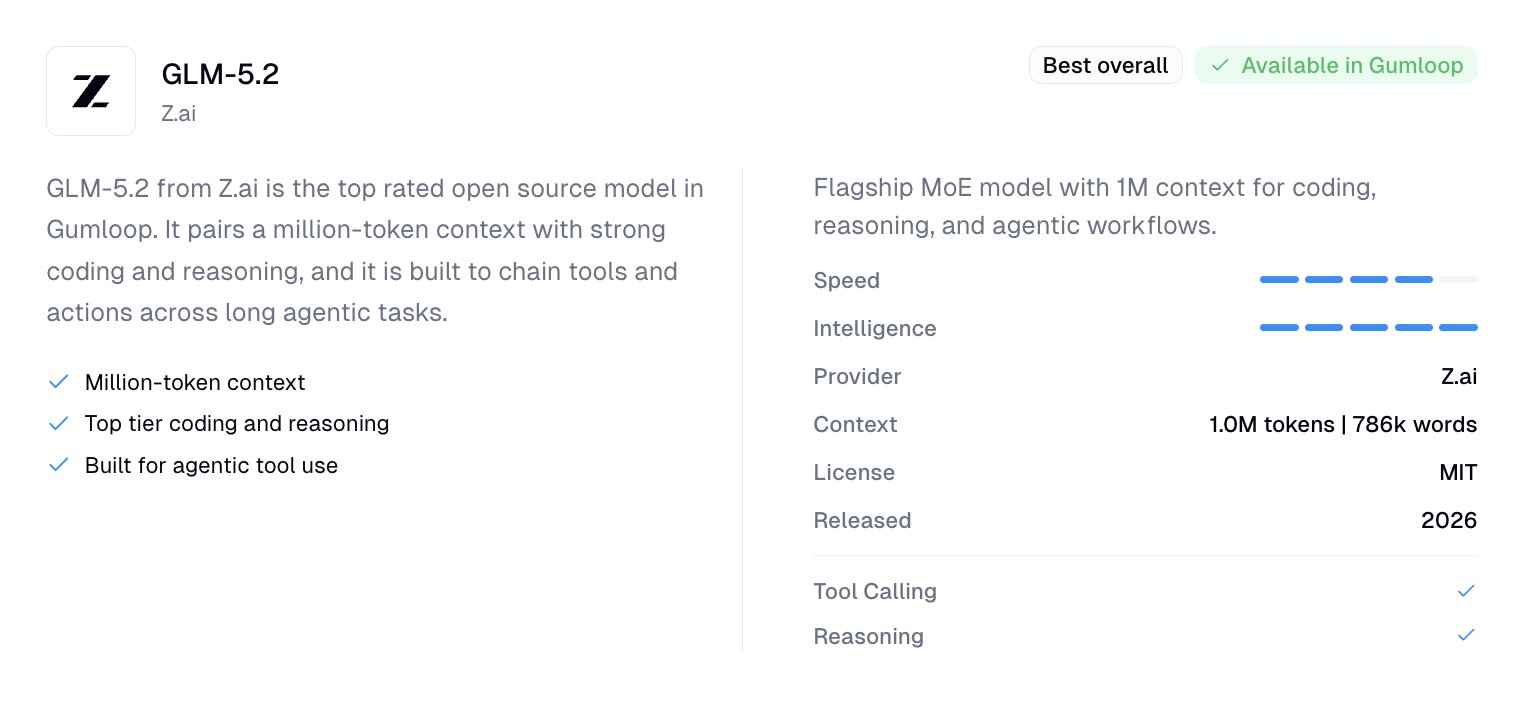
GLM-5.2 is an open weight model created by the AI lab Z.ai. It's their flagship model that is on par with frontier models like Opus 4.8, GPT-5.5, and Gemini 3.1 Pro.
It's rated as one of the top rated "open source" models and is know for its ability to tool call and reason on long-horizon tasks.
It's actually the model that I have used most of my AI agents to. I initially built my agents with Opus 4.8, but now that they run on GLM-5.2 I cannot tell a difference at all in the output.
Here is a video we did showing the output of an agent using both GLM-5.2 and Opus 4.8:
Pros and cons
Here are some pros and cons with GLM-5.2
Pros:
- It currently sits at the top of the Artificial Analysis Intelligence Index for open weight models, which puts it ahead of DeepSeek V4 Pro, MiniMax M3, and Kimi K2.6.
- The context window is 1 million tokens. That's a big jump from the 200k window in GLM-5.1 and enough to hold entire codebases or long research runs in a single session.
- It was built specifically for agentic work, so tool calling and multi-step tasks feel native
- The MIT license has no regional limits or usage restrictions, so you can fine-tune it or run it on your own infrastructure without asking anyone for permission.
- API pricing is a fraction of what comparable frontier models cost.
Cons:
- The full weights are around 1.5TB, so running it locally is out of reach unless you have serious hardware. Most people will use it through an API or a platform like Gumloop.
- It's text only right now. If your workflows need image or file inputs analyzed by the model itself, you will need a multimodal option.
Overall, GLM-5.2 is my go to option for agentic tasks. I was able to use 72% less credits in Gumloop when I switched from Opus 4.8 to GLM-5.2 so definitely recommend trying it for yourself.
2. DeepSeek V4 Pro
- Best for: Complex reasoning tasks
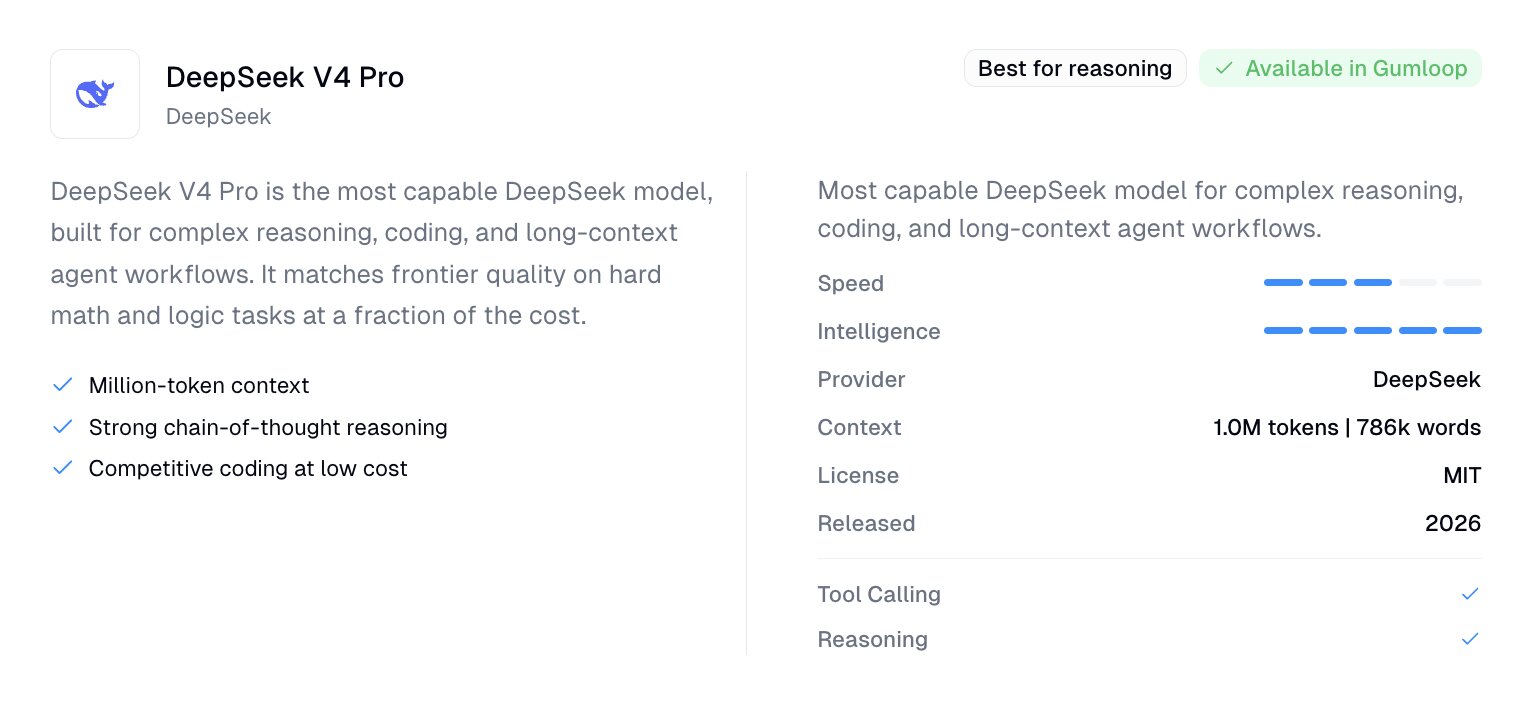
DeepSeek V4 Pro is a highly rated open weight LLM model created by DeepSeek. A while ago, they were known as an open source model with limited capabilities.
But today, DeepSeek V4 Pro is right up there with some older frontier models like Claude Sonnet 4.6. It was actually the model I started my open weight model journey with, so it has a special place in my heart.
V4 Pro is the bigger of the two models in the V4 family (the other is V4 Flash, which I cover later in this list). It's a 1.6 trillion parameter model, which makes it the largest open weight model anyone has released (so far).
It's a reasoning-first model, so it thinks through problems step by step before answering (which is sorta how GLM-5.2 also approaches reasoning tasks). And this is how I think it should be. Because when V4 Pro first launched, it led all open weight models on GDPval-AA, a benchmark that measures how well models handle real-world work tasks like the ones you would actually run in an agent.
GLM-5.2 has since taken the top spot, but V4 Pro is still one of the strongest agentic models you can run.
The context window is 1 million tokens, which is an 8x jump from the previous DeepSeek generation. So it can hold a lot of documents, data, or conversation history in a single run without losing the thread.
Pros and cons
Here are some pros and cons with DeepSeek V4 Pro:
Pros:
- It ranks first among open weight models on the GDPval-AA benchmark for real-world agentic work, ahead of Kimi K2.6 and GLM-5.1.
- The 1 million token context window handles long documents and multi-step agent runs without breaking a sweat.
- Per-token API pricing is low compared to frontier models with similar capability.
- The MIT license means you can use it commercially, fine-tune it, and self-host it with no restrictions.
Cons:
- All that step-by-step reasoning burns through output tokens, so your actual cost per task can end up higher than the cheap per-token price suggests.
- It tends to answer even when it does not know something, so I would double check its outputs on factual tasks.
- It's text only, so workflows that need the model itself to look at images will need a different pick.
- It can drop requirements on complex prompts with lots of constraints, which is where closed frontier models still hold an edge.
Overall, DeepSeek V4 Pro is a great entry point into open weight models. With the right harness, it's on par with some frontier models.
3. Kimi K2.7 Code
- Best for: Agentic coding and software engineering tasks
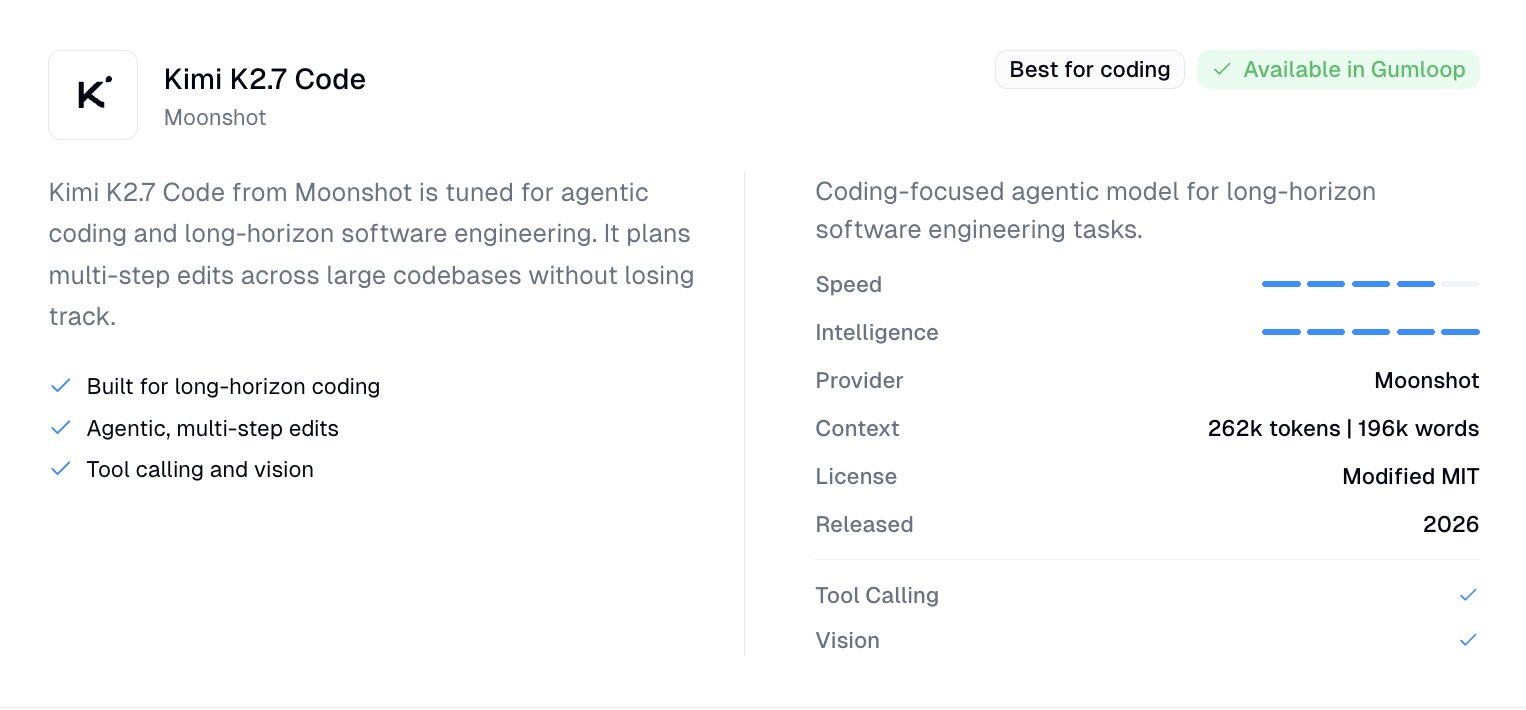
Kimi K2.7 Code is an open weight LLM model created by the team at Moonshot AI. What makes this model different is that it is a specialized mode.
Unlike the general-purpose models on this list, this one was designed specifically for coding. It came out in June 2026 as an upgrade to Kimi K2.6, and the whole point of it is completing long software engineering tasks from start to finish.
What makes it interesting is that it always thinks before it answers. You can't turn off the reasoning, but Moonshot has tuned the model to use 30% less thinking tokens than K2.6. So it reasons more efficiently.
It can also see images, which most open weight models on this list cannot do. You can drop a screenshot of a broken UI or an error message into your workflow and the model can actually look at it!
Pros and cons
Here are some pros and cons with Kimi K2.7 Code:
Pros:
- It's purpose-built for coding agents, with big reported gains over K2.6 on long-horizon software engineering tasks.
- Moonshot's numbers show it beating Opus 4.8 on MCP tool-use benchmarks, which matters if your agents rely on MCP integrations.
- It uses around 30% fewer reasoning tokens than K2.6, so agent runs cost less without giving up quality.
- Vision input is supported, so it can read screenshots, diagrams, and UI mockups inside a workflow.
Cons:
- The headline benchmarks are all Moonshot's own internal tests, so independent results are still catching up. I would run it on your own tasks before fully switching.
- The context window is 262k tokens, which is solid but well short of the 1 million you get with GLM-5.2 or DeepSeek V4 Pro.
- Thinking mode is always on, so quick simple tasks still pay the reasoning cost.
- The license is a modified MIT rather than pure MIT, so read the terms if you plan to self-host commercially.
Overall, this is a great open weight model if you are doing any coding tasks and don't need the latest Fable 5 "AGI is here" model.
4. Qwen3.5 397B
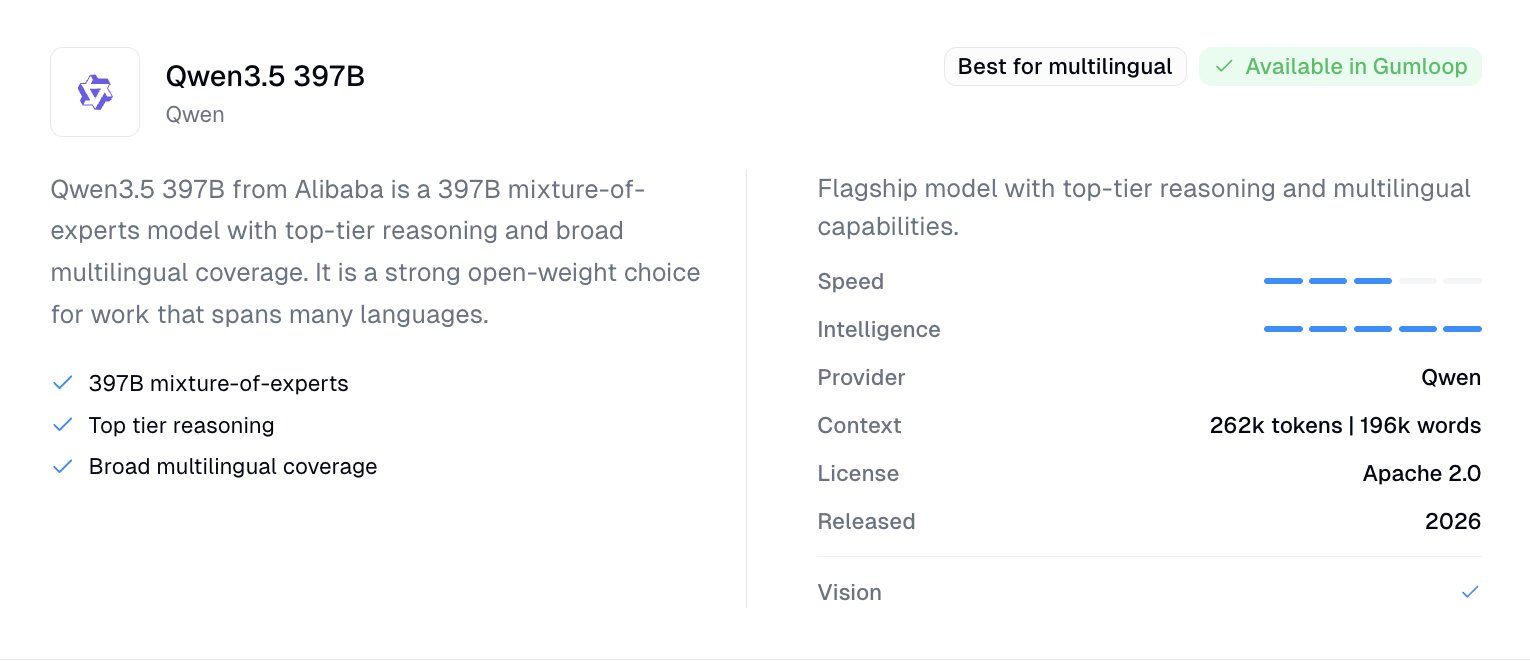
- Best for: Multilingual workflows
Qwen3.5 397B is an open weight LLM created by Alibaba Group. Yeah, that company that is known as the "Amazon of China."
The Alibaba Qwen team developed this model to be their flagship open weight release, and it ranks well above average for open weight models of its size on the Artificial Analysis Intelligence Index.
It's a Mixture of Experts (MoE) AI model with 397 billion total parameters, but it only activates 17 billion per token. What this means is that you get the intelligence of a huge model with the speed and cost of a much smaller one.
But where this Qwen model really shines in its language support. It knows 201 languages and dialects (up from 119 in the previous Qwen generation). If your workflows touch content, support tickets, or data in multiple languages, this is a model you should definitely check out.
It's also multimodal by default. From the beginning, the Alibaba team trained it on text and images at the same time. So it can read a UI screenshot, reason about a chart, or pull information out of a scraped document inside your workflow.
Pros and cons
Here are some pros and cons with Qwen3.5 397B:
Pros:
- It covers 201 languages and dialects, which makes it the strongest multilingual option on this list.
- Only 17 billion parameters activate per token, so it runs faster and cheaper than models with similar intelligence.
- Vision is built in natively, so it handles screenshots, charts, and documents without a separate model.
- The Apache 2.0 license is fully permissive for commercial use, fine-tuning, and self-hosting.
- It punches at the level of frontier models like Gemini 3 Pro and Claude Opus 4.5 on reasoning benchmarks.
Cons:
- The context window is 262k tokens in the open weight version. The 1 million token option only exists in Alibaba's hosted variant, so self-hosters are capped at 262k.
- Coding is good but slightly behind the top closed models and the coding-focused picks on this list.
- It came out in February 2026, so newer models like GLM-5.2 have passed it on some general benchmarks.
Overall, if you're running CSM (customer success management) workflows that require different language, this is definitely a model to look into.
5. DeepSeek V4 Flash
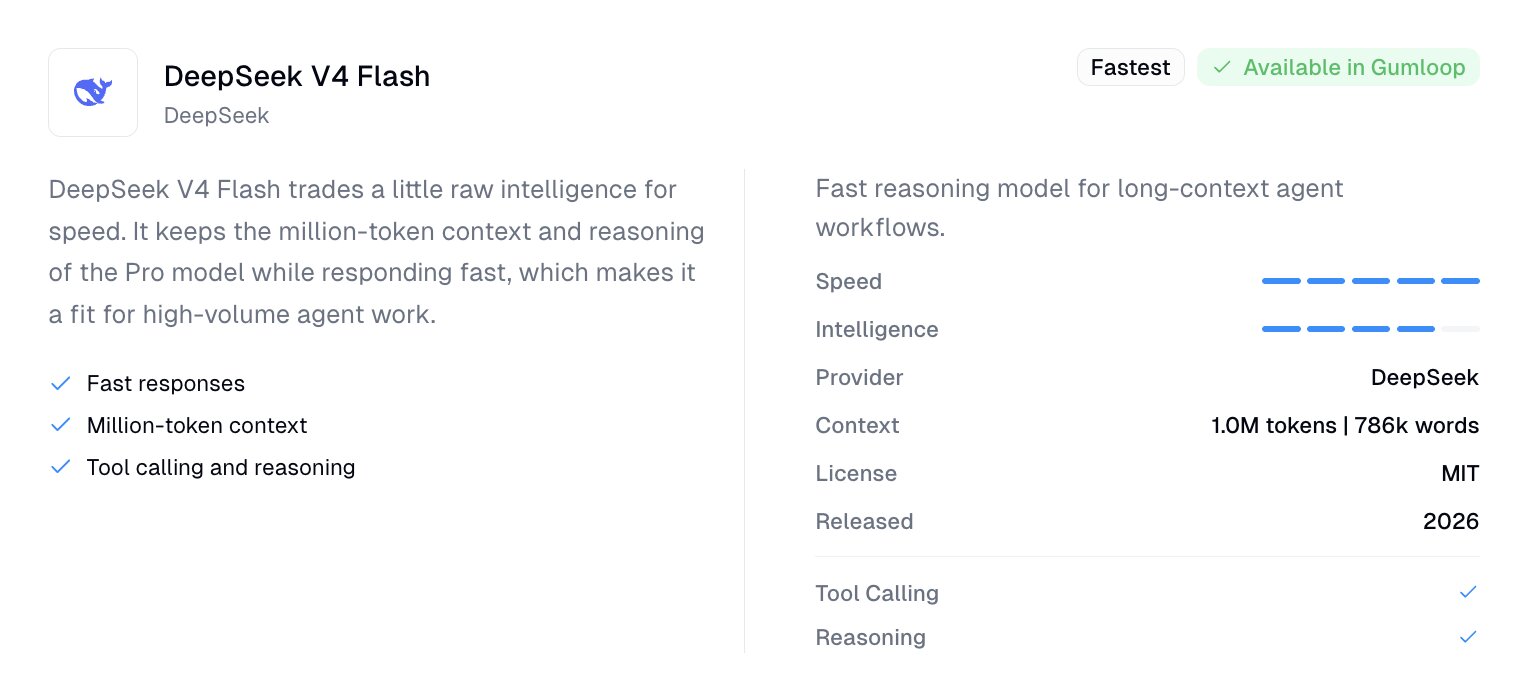
- Best for: High-volume workflows where speed matters
DeepSeek V4 Flash is an open weight model DeepSeek model that is focused on speed. It's the "less intelligent" but faster model of its premium version, V4 Pro (that we went over earlier).
So you might ask why use a less intelligent model? Or that it's better to have the model take longer if it means it will be "smarter."
Well, to understand why this tradeoff makes sense for some use cases, you have to look at what most automation work actually is. Most repetitive agent tasks are simple tool calls and a bit of reasoning that is referencing skill files. Things like summarizing rows in a spreadsheet, tagging support tickets, or pulling data out of emails. It's fairly simple.
Running a frontier model on these simple repeat workflows is a waste of credits. And this is where open weight models really shine.
DeepSeek V4 Flash also has three reasoning modes. You can run it with thinking off for quick tasks, or crank it up to max thinking for hard problems. At max effort it gets surprisingly close to V4 Pro on reasoning benchmarks, which is impressive for a model a fraction of the size.
And it's fast. It pushes out around 112 tokens per second, and pricing is peanuts for what this model is capable of. So if you're running an agent that processes hundreds of items a day, the savings compound fairly fast.
Pros and cons
Here are some pros and cons with DeepSeek V4 Flash:
Pros:
- It's one of the fastest open weight models available, which makes a real difference in high-volume agent runs.
- Pricing is extremely cheap, at a fraction of what V4 Pro costs per token.
- The 1 million token context window carries over from V4 Pro, so long documents and big agent runs still fit.
- Three reasoning modes let you match the thinking effort to the task instead of paying for max reasoning on everything.
- The MIT license has no restrictions on commercial use, fine-tuning, or self-hosting.
Cons:
- Knowledge is where the size reduction shows most. It knows less about the world than V4 Pro, so fact-heavy tasks are riskier.
- The most complex agentic workflows still favor V4 Pro, so I would keep Flash on the high-volume jobs and use Pro for the hard ones.
- It's very verbose. It generates far more tokens than comparable models to get to an answer, which eats into some of the per-token savings.
- Like V4 Pro, it's text only, so no images or screenshots.
Overall, DeepSeek V4 Flash is a great model if you already have an AI agent running a simple workflow that runs on repeat. I would not recommend it for reasoning heavy tasks. But if it's just simple read/write requests to tools (and for purely agentic workflows), then it's a good model to check out.
6. MiniMax M3
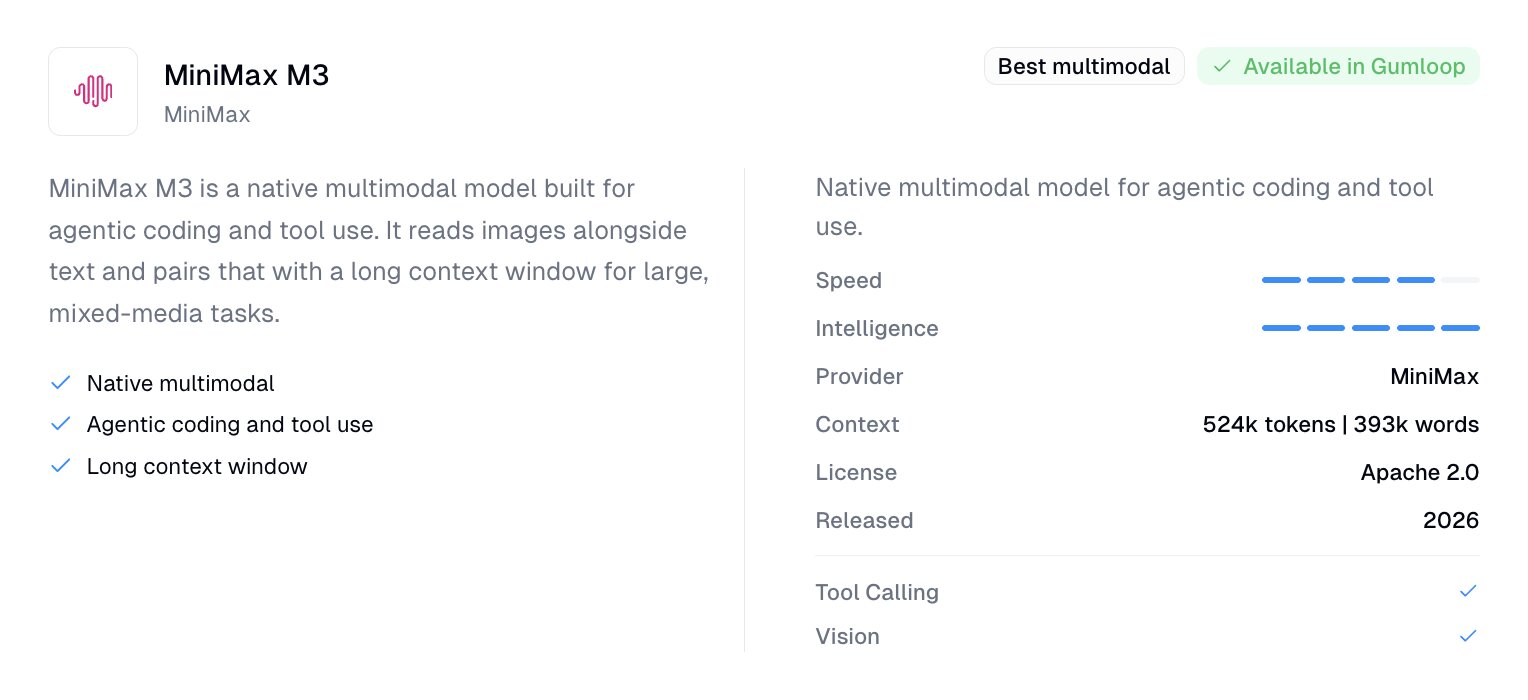
- Best for: Multimodal workflows with images and video
MiniMax M3 is an open weight model created by MiniMax, a Shanghai-based AI company. It came out in June 2026, and it's the best model (IMO) on this list for multimodal tasks. It can look at text, images, and even video! None of the other models here can watch a video and understand what it's about.
And just like other multimodal models, MiniMax trained this one on text and visuals at the same time. So the ability to understand visual is a core skill of the M3 model.
The M3 model is also known to have a really long context window. It uses a sparse attention design to only pay attention to parts of the context that matter, which makes million-token tasks a lot cheaper and faster to run. That's the problem MiniMax M3 aimed to solve. Long context windows look great on a benchmark, but it's usually slow and expensive.
While not expensive, this does make M3 slightly slower than some other open weight AI models we've gone over so far. But it does make the model a strong coder.
It's also a strong coder. MiniMax reports it beating GPT-5.5 and Gemini 3.1 Pro on SWE-Bench Pro, a tough software engineering benchmark, though it still falls short of Opus 4.8 on the hardest tasks (which is expected).
Pros and cons
Here are some pros and cons with MiniMax M3:
Pros:
- It's the only model on this list that handles video input, and one of the few with native image understanding.
- The sparse attention design makes long context practical, not just possible. MiniMax reports over 9x faster prompt processing at million-token lengths compared to their previous model.
- Coding performance is near the frontier. It reproduced an entire research paper's experiments in a 12-hour autonomous run, which shows how stable it is on long tasks.
- API pricing is very cheap for a model with this capability range.
Cons:
- The headline benchmarks were run on MiniMax's own infrastructure with favorable agent scaffolding, so treat them as a best case and test it on your own tasks.
- It's around 428 billion parameters, so self-hosting requires serious multi-GPU hardware.
- The hardest coding tasks still favor frontier closed models like Opus 4.8.
Overall, MiniMax M3 is a great model if you are doing agentic tasks that need a large context window. While not my ultimate go to choice for an open weight LLM, it does hold a special place in my heart as a long context window model.
7. Kimi K2.6
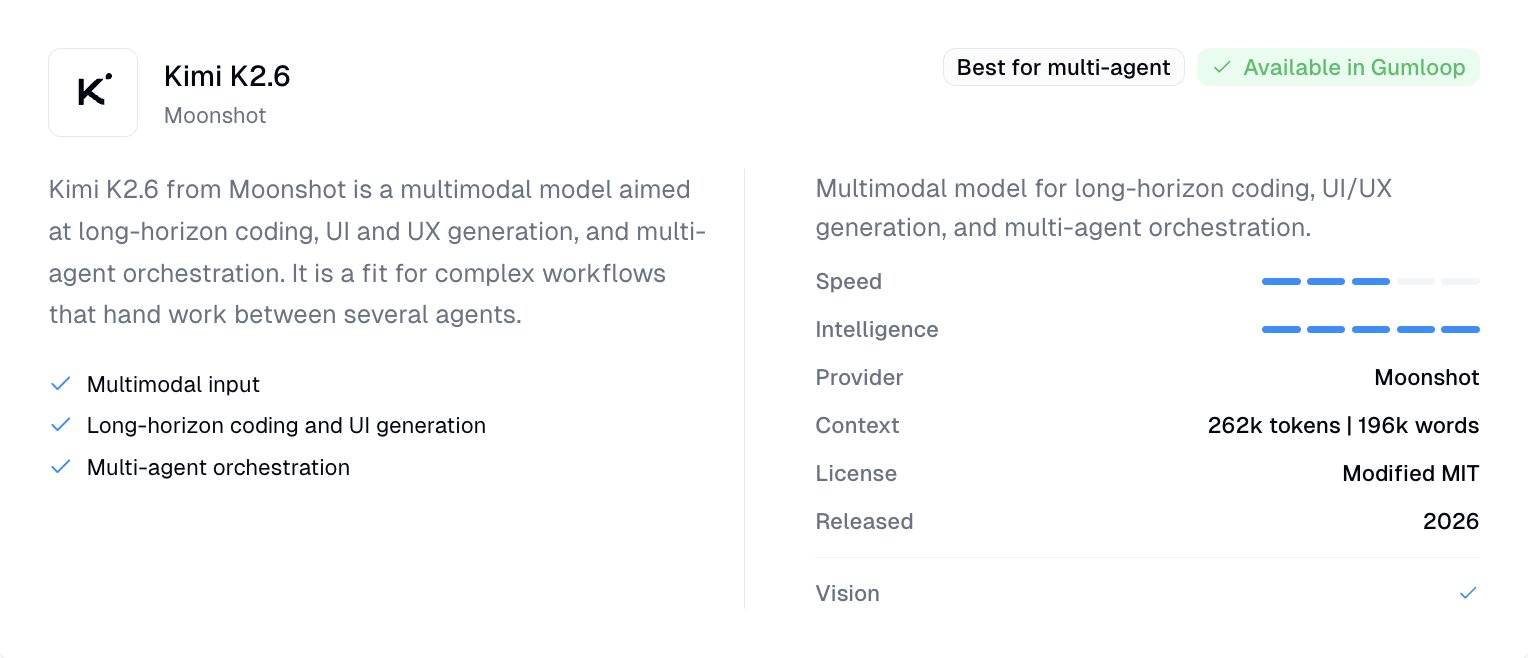
- Best for: Multi-agent orchestration
Kimi K2.6 is an open weight model created by Moonshot AI. The Kimi line was actually my introduction to using open weight models.
It's a 1 trillion parameter Mixture of Experts (MoE) model with 32 billion active per token, and it's the general-purpose sibling of Kimi K2.7 Code from earlier in this list. Where K2.7 Code went all in on software engineering, K2.6 covers a wider range. It handles images and even video input, generates full working interfaces from a prompt or a mockup, and runs long autonomous background tasks.
But the main value prop of this model is based on what Moonshot calls agent swarms. K2.6 can break a big task into parallel subtasks and coordinate up to 300 sub-agents running thousands of steps in a single autonomous run. If you're building multi-agent workflows where one agent delegates work to others, this is the model built for exactly that.
Unlike K2.7 Code, you can also turn thinking off. So quick tasks get instant answers while hard problems can still use full reasoning.
Pros and cons
Here are some pros and cons with Kimi K2.6:
Pros:
- It's built for multi-agent orchestration, with the ability to coordinate hundreds of sub-agents on a single task.
- Moonshot's published results show it beating GPT-5.4 and Gemini 3.1 Pro on agentic search benchmarks like DeepSearchQA.
- It takes images and video as input, and it's strong at turning visual mockups into working interfaces.
- Thinking mode is optional, so you control the speed and cost tradeoff per task.
- The weights ship natively quantized, which cuts the hardware requirements for self-hosting.
Cons:
- The context window is 262k tokens, which is behind the 1 million you get with GLM-5.2 or the DeepSeek models.
- Pure knowledge and reasoning still trail the frontier closed models, so it's the agent coordination that justifies the pick, not raw intelligence.
- Video input is still experimental and only works through Moonshot's official API, so it may not be available everywhere you run the model.
- Like K2.7 Code, the license is a modified MIT, so check the terms before commercial self-hosting.
Overall, Kimi K2.6 is a great model if you generate dashboards and care about building UI's. In other words, it's a good model for vibe coding simple HTML and CSS.
Which open weight model should you use?
After two months of testing, here's how I would break it down:
- Go with GLM-5.2 if you want the best overall option for agentic tasks. It's what most of my Gumloop agents run on today.
- DeepSeek V4 Pro is the pick for heavy reasoning workflows.
- Kimi K2.7 Code was built specifically for coding agents, so use it there.
- Qwen3.5 397B makes the most sense if your workflows touch multiple languages.
- DeepSeek V4 Flash will save you the most money on simple, high-volume automations.
- MiniMax M3 is the strongest choice for image and video understanding.
- Kimi K2.6 is the one for multi-agent workflows and generating UIs.
But honestly, the bigger takeaway from all this testing is where generative AI is heading. Open weight models used to be the "budget" option. Now they compete with frontier labs.
You still don't get everything with these models. The source code for the training process stays private, so full transparency is reserved for the handful of true open source projects out there. But you get access to the weights and the model architecture, which unlocks the same functionality you get when using ChatGPT or Claude. But, you have the customization, fine-tuning, self-hosting, and the freedom to switch anytime.
With closed source models, you're locked into one provider and whatever they decide to charge. With open weight models, the model is yours to run wherever you want.
That's exactly why we built Gumloop to have the best harness for open weight models. You can use any of the models on this list in Gumloop right now, swap between them from a dropdown, and run the same task side by side to see which one fits your workflow. That's literally how I do all of my testing.
Now go build some agents with open weight models!

Read related articles
Check out more articles on the Gumloop blog.