

5 best AI governance tools I've tested in 2026

Deploying AI across a large company can be a nightmare.
How do you make sure employees aren't entering sensitive company data into an agent?
How do you know if your AI vendor will eventually copy you and become a competitor?
How do you manage AI spend and find ways to lower costs over time (not have them increase at the mercy of a frontier lab)?
These are all questions AI governance tools aim to solve. Whether you're leading an IT department, or responsible for rolling out AI tools at your company, this is an article you want to pay deeply attention to.
I've been obsessed with AI ethics and governance for over two years now. And as someone who has deployed AI across my entire marketing and GTM team, I've constantly looked for tools that give me full control over how my team uses AI to get our work done.
So sit back, grab your favorite drink, and let's go over the top tools I've found that help with AI governance. But first, let's agree on a shared definition of what this space is and what these tools do.
What is an AI governance tool?
An AI governance tool is a platform that can integrate with your AI tech stack and lets you monitor, optimize, and set guardrails for how AI agents are deployed across an organization.
These tools can also help translate high-level regulations and internal policies into real controls, automate risk and compliance checks across the AI lifecycle, and generate documentation and audit evidence needed to prove responsible AI to regulators, customers, and your own leadership.
As AI agents become the norm in the workplace, these tools give IT, security, and compliance teams a way to keep control over technology that can read and write to internal systems, trigger actions, and access sensitive data, without slowing down innovation.
Okay now that we know what AI governance tools are, let me go over how I have evaluated these tools. Then, I'll go over my list of all the platforms I have personally tested and used.
How I chose the best AI governance tools
Picking the right AI governance tool is no easy task. The tool you pick sets the stage for all of your internal AI operations. So you don't want to take this decision lightly.
From all the AI governance tools I've found (that are actually reputable and used by Fortune 2000 companies), there are a set of features you have to pay attention to.
When picking the right AI governance tool I personally use, I went through this checklist:
- AI inventory: Can the platform discover and keep track of every agent, model, and AI tool being used across the company? You can't govern what you can't see.
- Continuous monitoring: Does it track how agents behave in real time, or does it only give you snapshots? You want to catch issues as they happen, not weeks later.
- Risk assessment and risk controls: Can it flag risky behavior (like an agent accessing sensitive data) and let you set risk controls to stop it before it becomes a problem?
- Ability to enforce policies: Can you define rules around what tools, data, and actions agents have access to, and actually enforce policies instead of just documenting them?
- Data governance: Does it give you control over what data agents can read and write to, especially when it comes to sensitive company or customer information?
- Compliance reporting: Can it generate the documentation and audit evidence you need for regulations and standards like GDPR, SOC 2, and the EU AI Act?
- Bias detection: If you're running models that make decisions about people, can the platform help you spot biased outputs before they cause harm?
- Cost visibility: Can you see and manage AI spend across teams so costs don't balloon as adoption grows?
Most of the tools on this list address everything I mentioned above.
Some of them are a bit more focused in certain areas. For example, Credo AI leans heavily into risk management and compliance reporting, while NeuralTrust and Wiz focus more on security and real-time enforcement. Gumloop covers the widest surface area since it combines the agent builder and the governance layer in one platform.
The goal here isn't to find the AI governance software with the longest feature list. It's to find the one that fits how your company actually uses AI and supports responsible AI adoption without slowing your teams down.
Okay, now lets get into the list!
5 best AI governance tools and software in 2026
Here are the top AI governance tools:
Alright, let's go over each of them.
1. Gumloop

- Best for: Enterprise teams who want full control and visibility over how AI is used across their company
- Pricing: Free plan available, then starts at $37/month
- What I like: The combination of an easy agent builder with a governance layer that IT departments actually want
Gumloop is an enterprise AI agent builder built for companies who want to have full control and visibility over how employees use AI. You can think of it as a glass pane between employees and AI.
In this context, AI consists of different LLMs (frontier models and open weight models) as well as tool calls to other tools in your tech stack (think Salesforce, Google Search Console, Gong, Firecrawl, etc.).
The platform also gives you a shared team environment for building, testing, and deploying AI agents and workflows without needing engineering help. This makes it great for companies who want to deploy AI agents internally but need one central place where people can create, edit, and share both agents and skills.

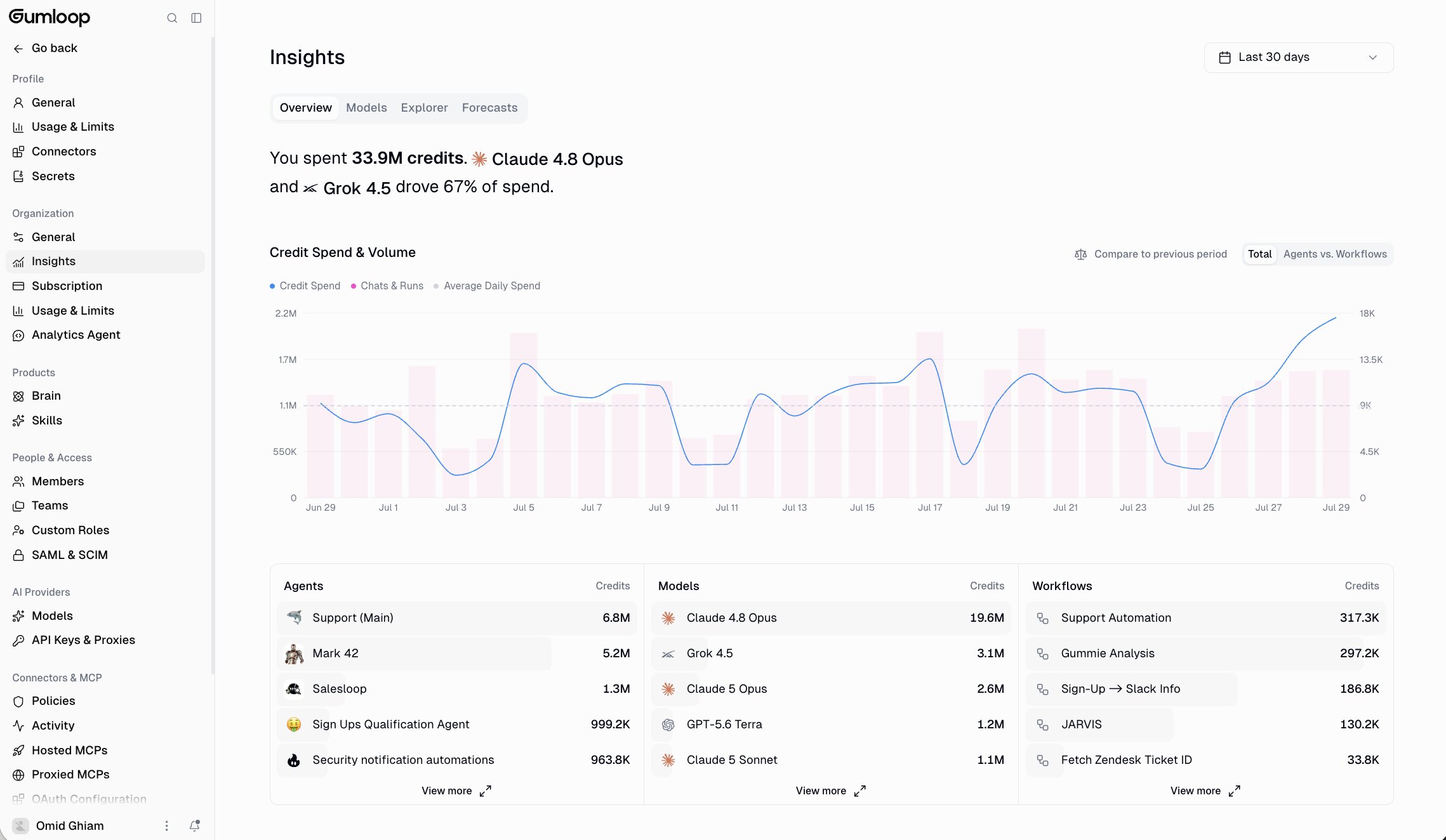
When it comes to governance features, Gumloop has Gumstack, an AI observability and security layer that helps teams monitor how agents are behaving. Everything from what models they're using, what tools they're accessing, and which employees are interacting with them can be tracked in Gumloop.
This is the core value prop of Gumloop. Create a platform that makes it easy to build, share, optimize, and control AI agents across an entire company. And it's no wonder why companies like Shopify, Ramp, Samsara, Gusto, and a ton more use Gumloop as their main enterprise AI layer.
How Gumloop works
Gumloop works by sitting between your employees and the AI systems they use. Instead of letting people build one-off automations or paste prompts into random tools, it gives them a centralized workspace to create agents and workflows that are reusable, editable, and visible to the broader team.
Users can connect LLMs to internal and external tools, then chain those actions together into workflows that handle real business tasks. For example, an agent might pull data from Salesforce, enrich it with search or scraping tools, summarize the results, and then pass the output into another system for follow-up.
That structure gives teams more consistency than ad hoc AI usage. It also makes it easier to govern who built what, which tools are being accessed, and how AI is being applied across the organization.
Now let's talk about some pros and cons. Because not every AI governance tool is perfect.
Here are some of the pros:
- Strong enterprise controls and visibility with its Insights feature
- Gives teams a shared environment where they can build and manage agents (you can share agents and skills like you would a Google Doc)
- LLM agnostic so you can either bring your own API keys or use the latest frontier or open weight models
- Great for IT departments who want to deploy AI across multiple departments while having control over access and AI spend
- Billing is based on overall company credit usage, so there is no limit to the number of user seats you can have
Here are some of the cons:
- Better suited for companies who already use AI agents or have a lot of AI-heavy tools
- While it is easy to build agents for non technical folks, much of the value comes from the AI governance and management side
- Will require enterprise pricing (to be expected) which can vary from company size to internal demand
Overall, Gumloop is a great choice for deploying AI across your org while also keeping full control over access and costs. It's number one on my list because I was a customer of Gumloop for two years until I decided to join the company to help lead growth. Can't imagine living without it now.
Gumloop pricing
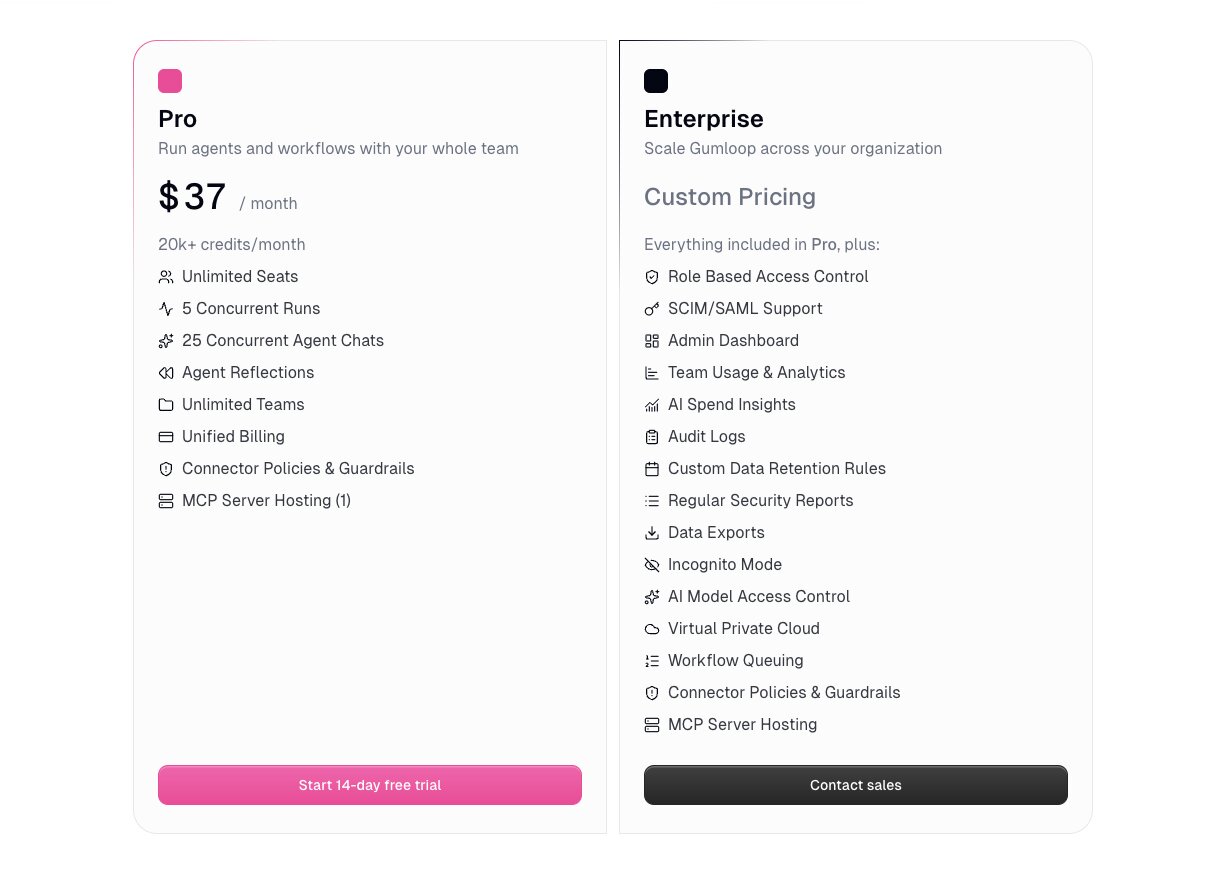
Here are Gumloop's pricing plans:
- Free: $0/month with 5,000 credits, 1 seat, 1 active trigger, 2 concurrent runs, 5 concurrent agent interactions, forum support, unlimited agents, and unlimited flows
- Pro: $37/month with 20,000+ credits, unlimited seats, 5 concurrent runs, 25 concurrent agent interactions, agent reflections, unlimited teams, unified billing, connector policies and guardrails, and MCP server hosting
- Enterprise: Custom pricing with role-based access control, SCIM/SAML support, admin dashboard, team usage and analytics, AI spend insights, audit logs, custom data retention rules, AI model access control, virtual private cloud, and workflow queuing
You can learn more about what each plan has to offer here.
Gumloop reviews
Here is what users rate Gumloop on third-party review sites:
- G2: 4.8/5 star rating (from +7 user reviews)
- Product Hunt: 5/5 star rating (from +9 user reviews)
2. Credo AI
- Best for: Companies that need a dedicated system of record for AI risk, policy, and compliance
- Pricing: Custom pricing, you need to book a demo
- What I like: The pre-built regulatory packs for major AI frameworks
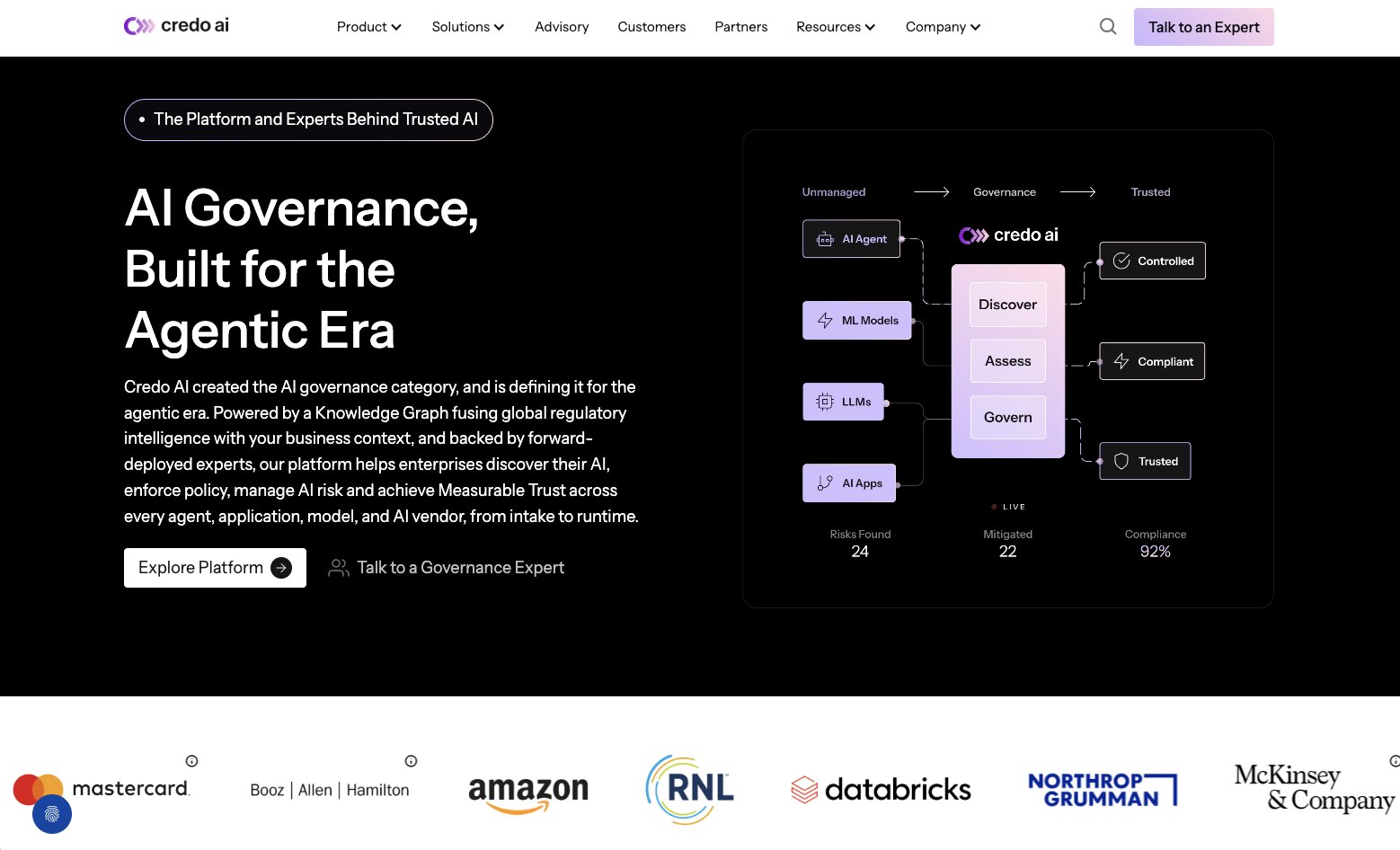
Credo AI is an AI governance tool built for companies already running AI agents. The platform helps you identify, assess, and monitor compliance of AI systems across your entire company.
So rather than having a built in agent builder and a governance layer (like Gumloop), Credo AI focuses more on giving you a platform that is solely based around governance of existing AI systems.
Think of it as a system of record for all things AI within your company. It's meant to give security and IT teams a place to responsibly operationalize AI, from policy, risk, and compliance.
How Credo AI works
Credo AI works by giving product, IT, legal, and data teams one central place to map controls to regulations and internal policies, so they can track AI compliance evidence.

The platform puts together a suite of tools to help you discover, register, assess, and control AI agents and systems in one place. They have a range of tools like:
- AI Registry
- Shadow AI Discovery
- Risk & Compliance Management
- Regulatory & Policy Intelligence
- Govern AI Assistant
All of these tools work together so you can maintain and control everything with how people use AI in your org.
Here are some of the pros:
- The built in regulatory features give you pre-built packs for major AI frameworks
- Has solid enterprise integrations and an SDK for creating custom AI workflows
- Focused on continuous context-driven governance across the entire AI lifecycle
- Built specifically for AI governance
Here are some of the cons:
- Pricing is a bit unclear and not transparent
- Great for policy documentation but lacks some features for real-time output guardrails from LLM models
- Does not have a lot of pre-built templates for niche industries or verticals
Overall, Credo AI is a solid platform if you need a central place where product, IT, legal, and data teams can use AI agents while IT departments can have full control and governance.
Credo AI pricing
Credo AI does not list its pricing publicly. You will need to book a demo with their team to get a quote based on your company size and needs.
Credo AI reviews
Here is what customers of Credo AI rate the platform on third-party review sites:
- G2: 4/5 star rating (from +3 user reviews)
- Gartner: 5/5 star rating (from +2 user reviews)
As you can see, there are not a lot of publicly available reviews. So take these with a grain of salt.
3. Fiddler AI

- Best for: IT and data science teams who need deep monitoring and explainability for LLMs and ML models
- Pricing: Free plan available, then $0.002 per trace on the Developer plan
- What I like: The explainability features that help you understand model decisions and find root causes of issues
Fiddler AI is an agent governance platform designed to help IT departments run experiments, monitor, set guardrails, and govern AI across their organization.
The platform acts as a control center for different large language models and agents. It's used by IT, engineering, data science, and trust/safety teams. Basically anyone who wants to deploy AI company-wide responsibly.
How Fiddler AI works
The way you use Fiddler AI is by integrating it with your other AI tools so Fiddler can collect traces, metrics, and outputs. From there you can visualize them in a dashboard and create different reports.

When things like AI hallucinations or unauthorized tool calls occur, the platform gives you alerts with human-in-the-loop workflows. So if you need a platform that has a trust layer on top of your existing AI agent stack, this is a tool to look into.
Here are some of the pros:
- Great monitoring features for both LLMs and traditional ML
- Explainability features are often the most favorite from customers due to its ability to understand model decisions and find root causes of issues
- Solid set of integrations with MLOps stacks so it's easy to plug right into the platform
- Clear pricing plans that make it easier than most AI governance tools to track costs
Here are some of the cons:
- Not the easiest platform to use, there will be a learning curve if you have never used an AI observability platform
- The platform is a bit more focused on model-centric monitoring over deep agentic usage insights (something Gumloop solves)
Overall, Fiddler AI is a solid choice for an AI governance platform. It's no wonder why companies like Mastercard, Thumbtack, Ally, AAA, and a ton more use them.
Fiddler AI pricing
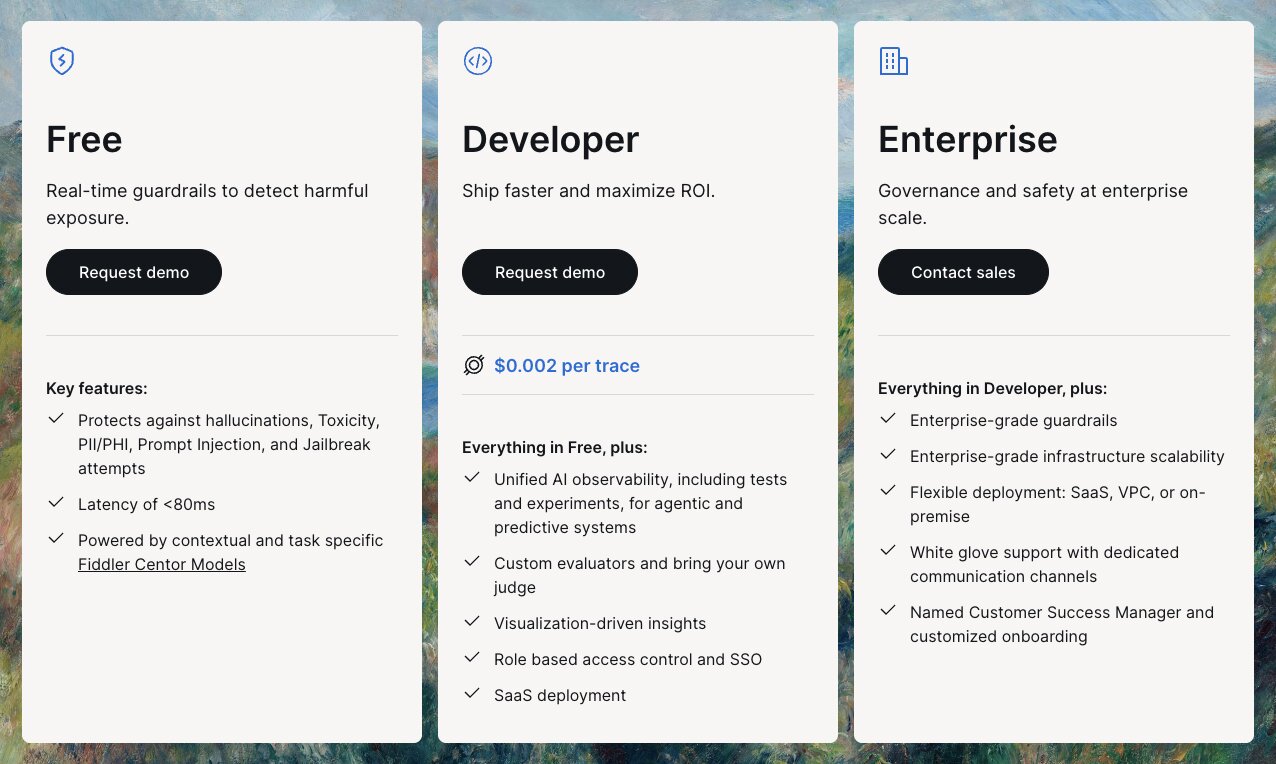
Here is how Fiddler AI's pricing works:
- Free: $0 with real-time guardrails that protect against hallucinations, toxicity, PII/PHI, prompt injection, and jailbreak attempts, with latency under 80ms
- Developer: $0.002 per trace with unified AI observability, custom evaluators, visualization-driven insights, role based access control and SSO, and SaaS deployment
- Enterprise: Custom pricing with enterprise-grade guardrails, infrastructure scalability, flexible deployment (SaaS, VPC, or on-premise), white glove support, and a named customer success manager
You can learn more about what each plan has to offer on their pricing page.
Fiddler AI reviews
Here is what customers of Fiddler AI rate the platform on third-party review sites:
- G2: 4.3/5 star rating (from +3 user reviews)
- PeerSpot: 4/5 star rating (from +5 user reviews)
4. NeuralTrust

- Best for: Large enterprises that need real-time security and policy enforcement across their AI agents
- Pricing: Custom pricing, you need to contact their team
- What I like: The real-time enforcement on AI tool calls at 20k+ requests per second
NeuralTrust is an AI governance and security platform for agents. It's a centralized platform that lets you discover and secure all of your agents across your entire organization.
The platform works by grouping together a set of features across Discover, Evaluate, Respond, and Enforce. All of these work together to give you full control over how people are using agents as well as the outputs that those agents are producing. Everything from reasoning to planning to action of agents can be monitored and tracked.
You can also set policies and look at analytics of what tool calls are being made and get alerts when something needs your attention.
How NeuralTrust works
NeuralTrust works by first discovering all of your agents, tools, and workflows that are across your organization.
Once it does an audit and is integrated into your AI tech stack, it will monitor your agent's behavior, analyze requests and responses, and also use behavioral and contextual analysis to track any cyber attacks, policy violations (that you set), or even data leaks.
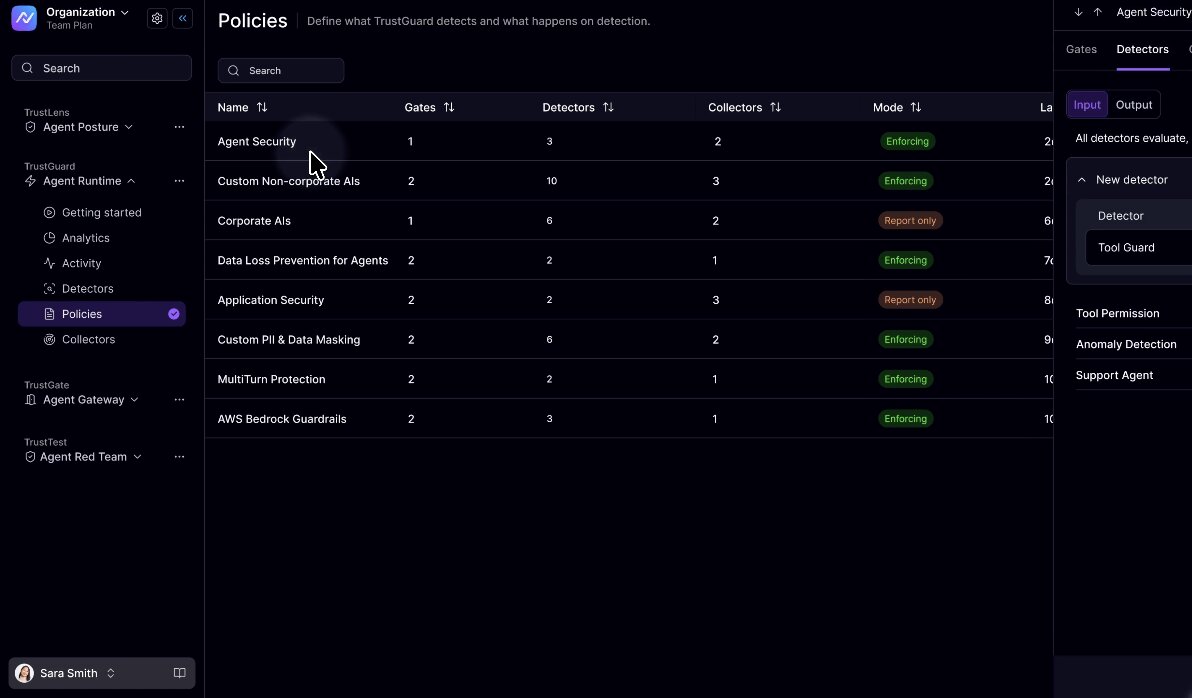
From there, you can set different guardrails and define policies for your agents. For example, you can set policies that deny access to certain tools or data that agents can read or write to. You can also set policies around actions that agents are allowed to execute, as well as any content that should be blocked and not read by the agent.
Here are some of the pros:
- Built specifically for agent security so it's more than just a generic model monitoring platform
- It gives you real-time enforcement on all AI tool calls with super high scalability at 20k+ requests per second
- Its suite of features gives you a fully closed loop that lets you detect behavioral, contextual, multi-turn, multilingual analysis, and a ton more
Here are some of the cons:
- It's designed for large enterprises that have a ton of AI tools already, so it's not great for smaller teams or if you just need to simply analyze LLM behavior
- Has a strong focus on agents over classic ML model performance. If you need to monitor the accuracy of traditional models, then this might not be the best tool
Overall, NeuralTrust is a promising and rising platform in the AI governance tools space. It's used by some pretty big companies like Iberia and Air Europa. So it does tend to have a more international customer base. If you are based in the US, it might be worth looking into an alternative.
NeuralTrust pricing
NeuralTrust does not list its pricing publicly. You will need to contact their team and book a demo to get a quote based on your company size and needs.
NeuralTrust reviews
NeuralTrust is a pure enterprise platform, and there are no public user reviews from third-party websites.
5. Wiz
- Best for: Security teams with large cloud environments who want AI governance built into their cloud security stack
- Pricing: Custom pricing, you need to book a demo
- What I like: The security graph that contextualizes AI risks within your full tech stack
Wiz is a cloud security company for all AI cybersecurity needs. At first, it doesn't seem like an AI governance tool, but they have now expanded to AI agents.
Today Wiz can connect to your codebase, cloud, and AI stack to give you a full agentic security platform. From there, the platform can find attack paths and monitor any AI tools for risk of data leaks, prompt injection, unsecure guardrails, or misfired AI workflows.
Instead of focusing on policy workflows and compliance documentation like Credo AI does, Wiz focuses on helping you build a security graph over your multi-cloud and AI footprint.
From there, it prioritizes and fixes issues that are exploitable, especially those that involve AI agents or applications.
How Wiz works
Wiz works by integrating with your cloud accounts. It scans your configurations, workloads, identities, and data. From there, it creates a security graph to show you any current vulnerabilities, so in essence it first starts off with a full audit.
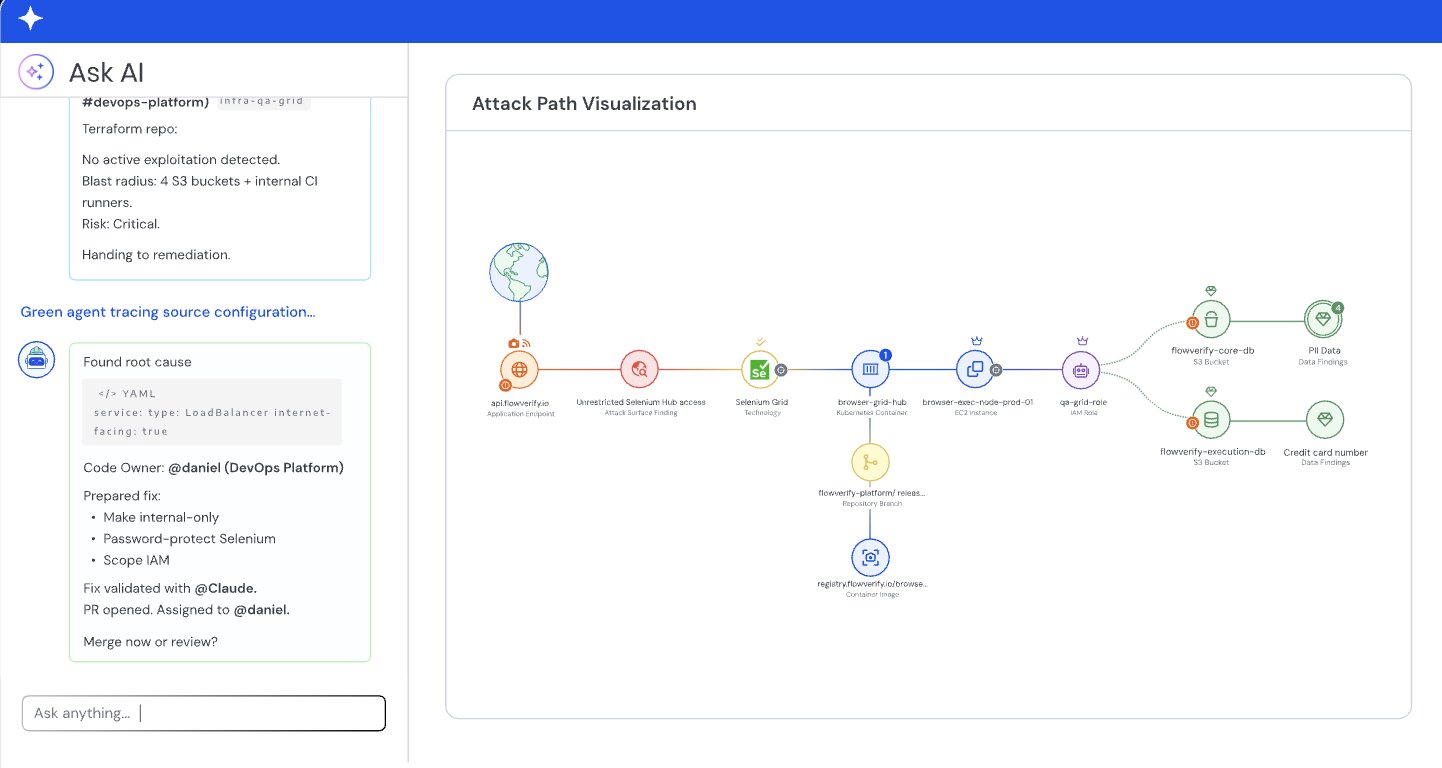
From there, you can set different policies or rules on things you want to analyze, like:
- Exposed endpoints
- Guardrails
- Sensitive training data
- Logic flaws
And connect those to your broader cloud context. Wiz can then detect threats like agents going rogue or having malicious behaviors, and also how they're calling tools and data.
Here are some of the pros:
- Has strong multi-cloud visibility features that can contextualize any risks within your full tech stack
- Has mature CSPM features that can integrate with LLMs from frontier AI labs
- Specifically designed for AI-SPM and AI-APP features for discovering AI agents and models and managing any AI risks associated with them
Here are some of the cons:
- Designed first for security teams with large cloud environments. It's not great for smaller companies as it will feel overkill
- While it does have AI governance features, it's mainly focused on security and posture
Overall, Wiz is a really reputable company trusted by security and IT teams at Chipotle, DocuSign, Lovable, Salesforce, and more.
If you are in the market for something that can integrate with cloud security features, then this is a no brainer as it also includes AI governance features. But if you're looking for an AI governance-first platform, it might be worth looking at one of the tools I mentioned earlier in this list.
Wiz pricing
Wiz does not list its pricing publicly. You will need to book a demo with their team to get a quote based on your cloud environment and needs. You can learn more on their pricing page.
Wiz reviews
Here is what customers of Wiz rate the platform on third-party review sites:
- G2: 4.7/5 star rating (from +838 user reviews)
- Capterra: 5/5 star rating (from +2 user reviews)
Which AI governance tool should you choose?
Remember those questions from the beginning of this article? How do you stop employees from pasting sensitive data into an agent? How do you keep AI spend from ballooning? These are the questions your choice should answer.
If you want one platform where teams can build AI agents while IT keeps full control over access, costs, and data security, go with Gumloop. It gives you the agent builder and the governance layer in one place, with audit trails and AI spend insights baked in. It's the tool I use every day, so I am biased, but I was also a paying customer long before I joined the team.
If your main concern is compliance and mapping your AI systems to regulatory frameworks like GDPR or the EU AI Act, Credo AI is your best bet. It's built for risk tiering, policy documentation, and generating the compliance evidence regulators want to see.
And if you're a security team with a large cloud footprint, where your data lives across AWS, Snowflake, and a dozen other platforms, Wiz makes the most sense. It treats AI governance as an extension of cloud security, which matters if things like data residency requirements keep you up at night.
Whatever you choose, don't wait until an AI incident forces the decision for you. Your employees are already using AI. The only question is whether you can see it.

Read related articles
Check out more articles on the Gumloop blog.