

5 best AI agents for enterprise teams in 2026

I remember the first time I felt the magic of an AI agent at work.
I used an agent that connected to our BigQuery and PostHog analytics and asked it to run a cohort retention analysis.
Something that would have taken me an engineer's help and probably 2 weeks to build, my agent just did it all in less than a minute.
As a growth operator, using agents has been an insane unlock. And I don't think I could go back to creating dashboards manually or looking through our data "the old fashioned way" anymore.
But that's just one way of AI agents for enterprise use cases. There are so many others that span other marketing/growth roles, sales/GTM roles, support roles, operations roles, and so on.
So in this article, I want to show you some of my top enterprise AI agents I have tested and used. I went over all the pros and cons of each and how each of them stands out.
They all serve different purposes, but I'm sure you'll find one that fits the level of premium quality you're looking for. But before we get into the list, let's go over some important semantics.
What is an enterprise AI agent?
An enterprise AI agent builder is a platform for building agentic workflows that are secure and can be shared across an organization. They are different from traditional agent builders in that they are built with security and access controls in mind.
There's a good chance you've already used ChatGPT or Claude for a lot of your professional (and even personal) tasks. I know I've used Claude Projects and Claude Cowork for a ton of tasks in the past.
But the issue with tools like that is that they are single player, and integrating tools that house sensitive data can be risky.
On the other hand, AI agents built for enterprise companies take on a more multiplayer approach, where someone on your team can create an agent that can be used across an entire organization.
And at the same time, those agents have a security layer IT departments can monitor to see how employees are using agents, what tools those agents call, and what data those agents have access to.
This is important because it prevents sensitive company data from leaking into tools that were never approved, and it gives leadership visibility into how AI is actually being used across a company on a day to day.
The best enterprise AI agents also include things like role-based access control, audit logs, SSO, and the ability to deploy inside your own cloud. These are the features that separate a true enterprise tool from a consumer AI product someone happens to be using at work.
What are examples of AI agents in enterprise settings?
The magic of AI agents comes from the data they have access to. And from my own experience, my aha moment came when I used an internal agent at my company that had access to my customer data.
AI agents are only as useful as the tools they can call. So the case for an enterprise solution comes when you have data that cannot be leaked or have an agent go rogue and mess up your database or other internal tools.
When you have that security and sharability, you unlock a ton of use cases for agents across your org. You can use it for things like:
- Sales and revenue: Lead qualification agents that enrich inbound leads, score them, and route them to the right rep. Or CRM hygiene agents that update Salesforce or HubSpot records and flag stale opportunities.
- Customer success and support: Tier-1 ticket triage agents that classify, prioritize, and auto-respond to common support tickets before a human touches them. Or account health agents that track usage patterns and flag churn risk to CSMs.
- Marketing and growth: Content repurposing agents that turn webinars or podcasts into blog posts, social clips, and email campaigns. Or competitive intelligence agents that track competitor pricing, launches, and messaging changes across the web.
- Finance and operations: Invoice processing agents that extract data, match to purchase orders, and flag discrepancies. Or expense auditing agents that review reports against company policy and flag violations automatically.
- IT and security: Incident response agents that detect alerts, gather context from logs and dashboards, and page the on-call engineer. Or access provisioning agents that handle onboarding and offboarding across your SaaS tools.
- Data and analytics: Report generation agents that query your databases, build charts, and deliver recurring business reports. Or ad hoc analysis agents that let non-technical teammates ask questions in natural language and get real answers back.
The common thread across all of these is that agents sit between tools and skills your team gives them. They can help speed up tasks, enforce consistency, and free your team up to focus on the judgment-heavy work instead of repetitive stuff.
Okay, now lets go over the best AI agent builders for enterprise companies.
5 best AI agents for enterprise companies in 2026
Here are the best AI agents builders for enterprise:
Alright, lets go over each one.
1. Gumloop
- Best for: Enterprise teams that want to securely share AI agents and skills across their organization
- Pricing: Free plan available, Pro starts at $37/month, Enterprise is custom
- What I like: Self-serve onboarding with an enterprise-grade security layer called Gumstack
Gumloop is an AI agent platform built for companies that want to securely share agents and skills across their team. The platform was built with enterprise in mind, but it has a self-serve feature that separates it from other enterprise AI agent builders out there.
Anyone can sign up for Gumloop and experience its magic. But on the Enterprise plan, you get access to Gumstack. This is the security layer that Gumloop has built specifically for security teams who want full control over how their organizations can use agents (and what tools or data agents have access too).
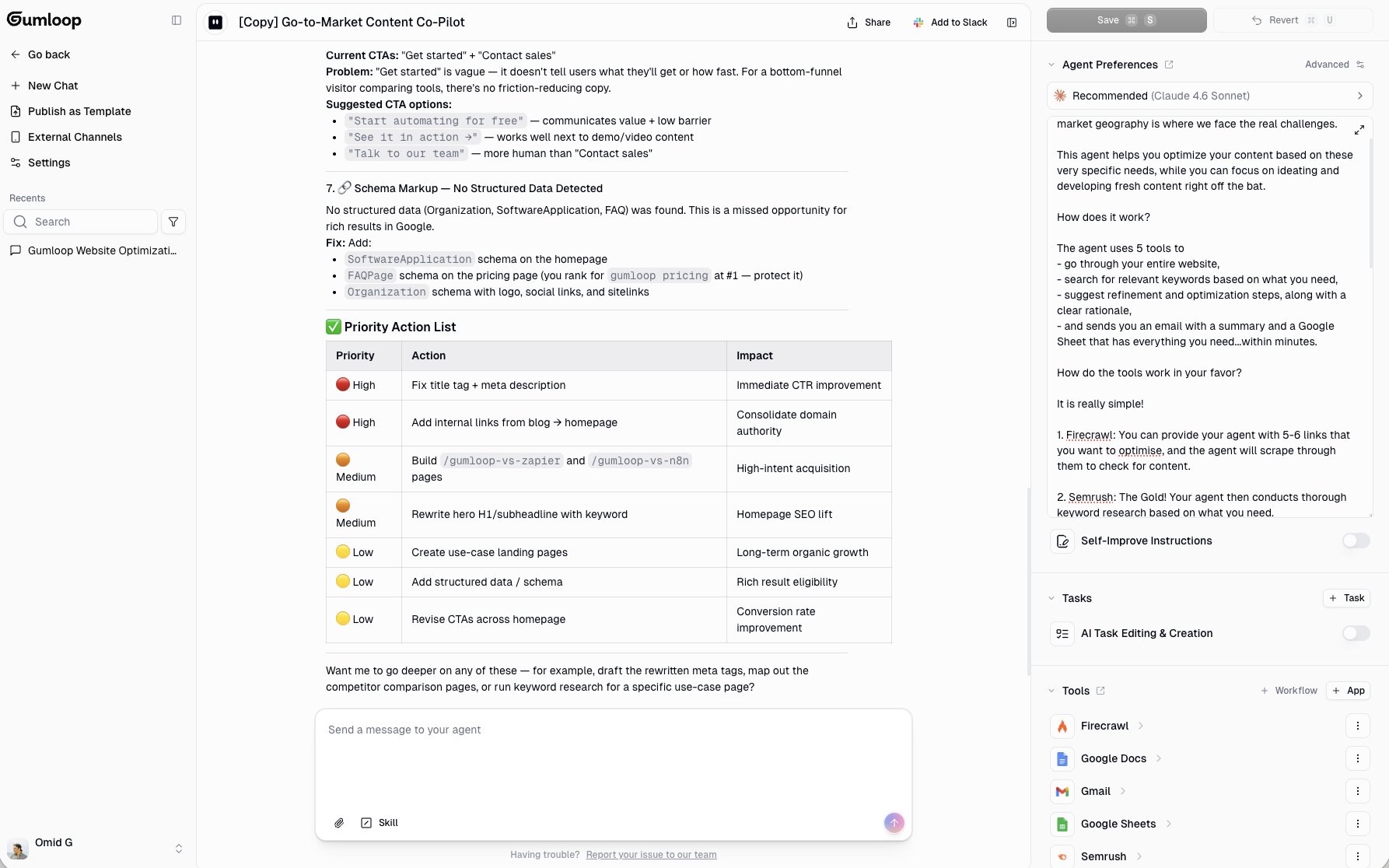
What makes Gumloop different than something like Claude Cowork, for exmaple, is that it's a multiplayer tool. It handles multi-agent orchestration across an entire team. You can spin up specialized agents for different teams, like a Data Analysis Agent for GTM, a Support Agent for your customer success team, or a CRM Agent for your sales team. And then you can orchestrate them all from a chat interface inside of Gumloop, or bring your agents into Slack (which is how I use it).
The platform is used by companies like Shopify, Instacart, Gusto, Ramp, Samsara, and tons of other AI-forward companies. So it has been rigorously tested for large organizations that care about compliance, observability, and rolling out AI across multiple departments.
Some things I like about Gumloop:
- Built with enterprise security in mind, but still has a self-serve flow that anyone can sign up for
- Gumstack acts as a single pane of glass for every MCP client and server across your organization
- Comes with every major LLM out of the box, so you do not need to manage a bunch of separate API keys (although, you can bring your own API keys as well)
- Your team can interact with agents directly in Slack, Microsoft Teams, Gmail, or WhatsApp
Some things I do not like:
- The learning curve can feel steep in the first 20 minutes before things start to click (you'll likely want to join a cohort to quickly see the magic it has)
- The template library is still growing compared to tools that have been around for a while
Overall, Gumloop is the platform I recommend to enterprise teams that want to give their employees real AI agent capabilities without losing control over security, access, and spend.
The ability for someone to create an agent, then share it with others (who can also improve on the skills), is unmatched. I still have yet to see another platform make this as easy and safe as Gumloop does.
Gumloop pricing
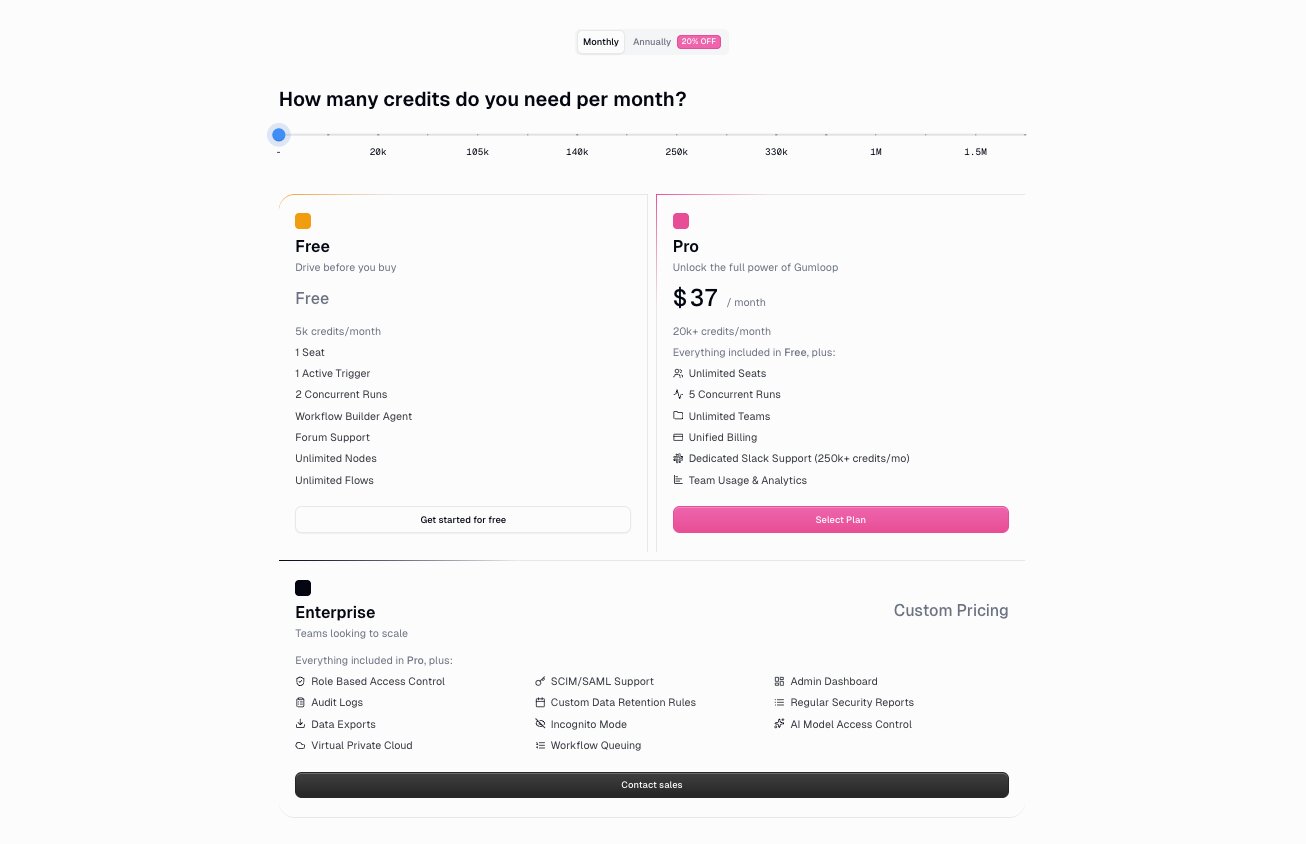
Here are Gumloop's pricing plans:
- Free is $0/month with 5k credits per month, 1 seat, unlimited agents, and unlimited flows
- Pro starts at $37/month with 20k+ credits per month, unlimited seats, unlimited teams, team usage and analytics, and unified billing
- Enterprise is custom pricing with everything in Pro plus Gumstack, role-based access control, SCIM/SAML support, audit logs, virtual private cloud, AI model access control, and MCP server hosting
You can learn more about what each plan includes on their pricing page.
Gumloop reviews and ratings
Here's what others say about Gumloop on third-party review sites:
- G2: 4.8/5 star rating (from +7 user reviews)
- Product Hunt: 5/5 star rating (from +9 user reviews)
2. StackAI
- Best for: Enterprise teams in regulated industries like finance, healthcare, and legal
- Pricing: Free plan available, Enterprise is custom pricing
- What I like: Built specifically for document-heavy workflows in regulated industries
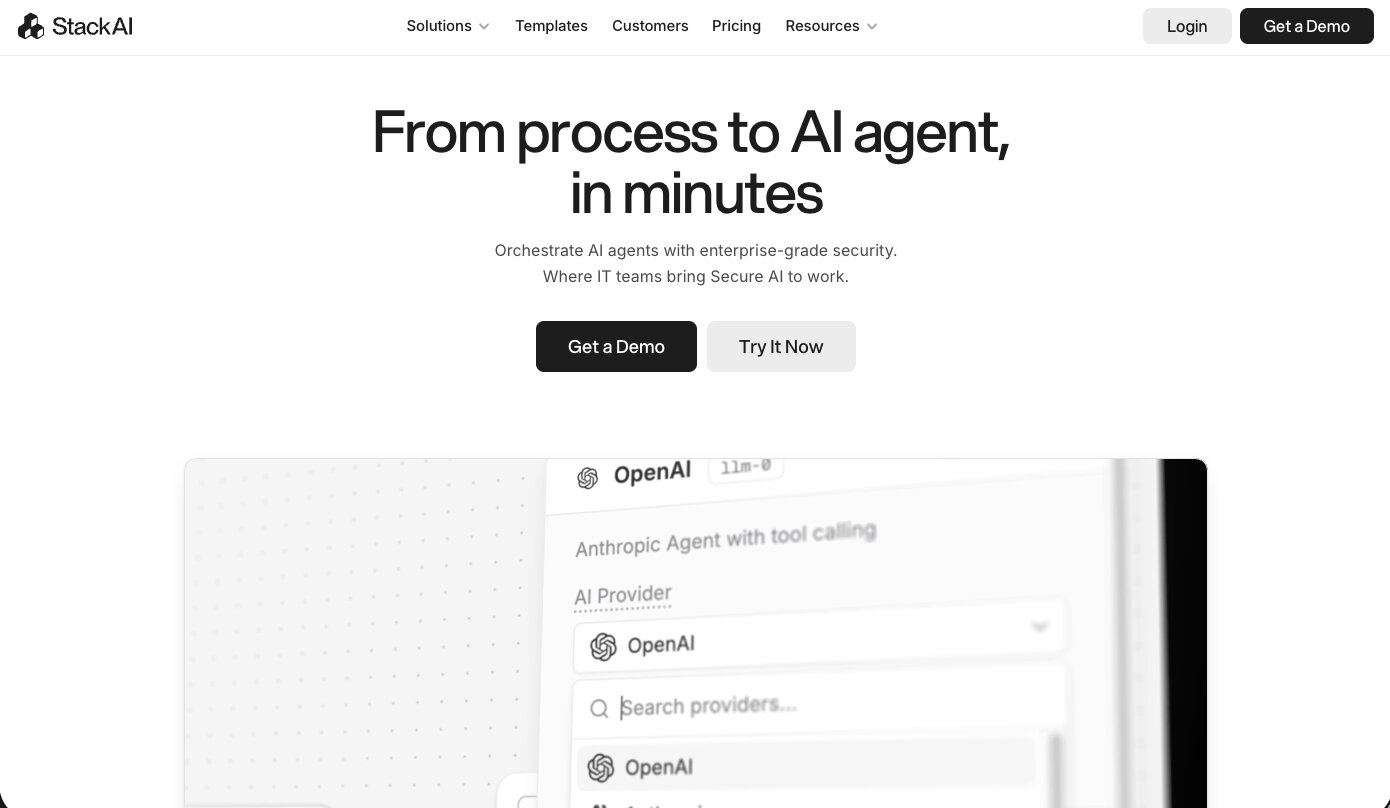
StackAI is an enterprise AI agent builder designed for companies in industries like healthcare, legal, finance, and risk/compliance. It is built for teams that are very document heavy and need agents to help them synthesize and analyze documents.
What makes StackAI different from a lot of the other platforms on this list is how focused it is on regulated industries. The platform supports on-prem deployment, virtual private cloud, and compliance with SOC 2, HIPAA, and GDPR. So if you are at a bank, an insurance company, or a healthcare provider, this is one of the few platforms that can actually deploy inside your environment.
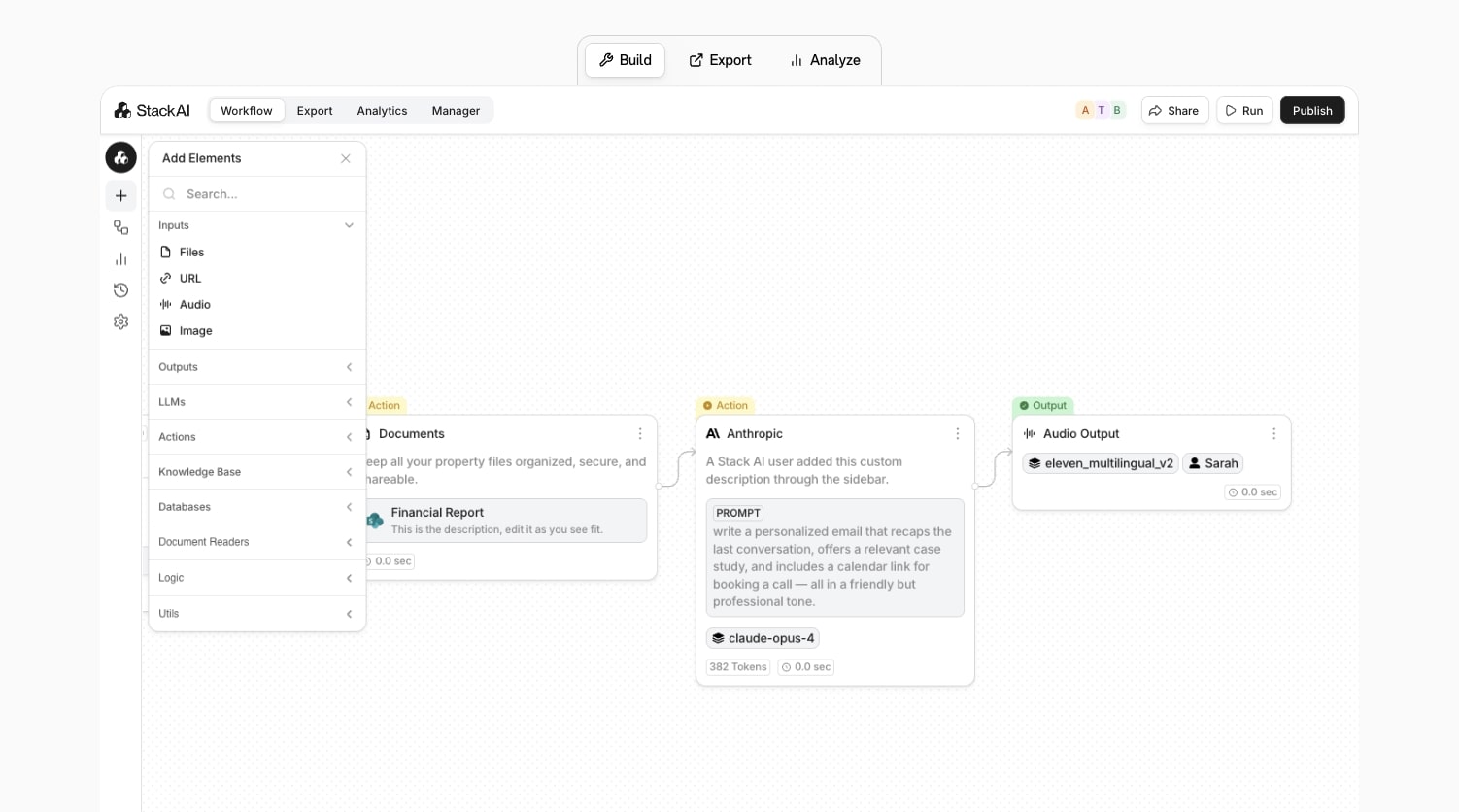
The platform has a visual workflow builder (one of my favorite UIs to be honest) where you can drag on different nodes, connect to over 100 enterprise integrations, and pull in knowledge bases so your agents can retrieve information from internal documents. It is also LLM agnostic like Gumloop, so you can pick the best model for each specific task inside a workflow.
Some things I like about StackAI:
- It is one of the few AI agent builders that actually supports on-prem deployment for teams that cannot use cloud-hosted tools
- The knowledge base feature makes it easy to ground your agents in your own documents and data
- Human-in-the-loop controls let you add approval steps at key decision points, which is a big deal for regulated workflows
- Comes with enterprise compliance out of the box (SOC 2, HIPAA, GDPR)
Some things I do not like about StackAI:
- The free plan is limited to 500 runs per month and 2 projects, so you will hit the ceiling quickly if you try to test it beyond a small proof of concept
- Pricing is not transparent for the Enterprise plan, so you will need to book a call to get a quote
Overall, StackAI is a great choice if you work in a regulated industry and need an AI agent builder that can handle compliance, on-prem deployment, and document-heavy workflows. For teams outside those industries, there are simpler and more flexible options on this list.
StackAI pricing
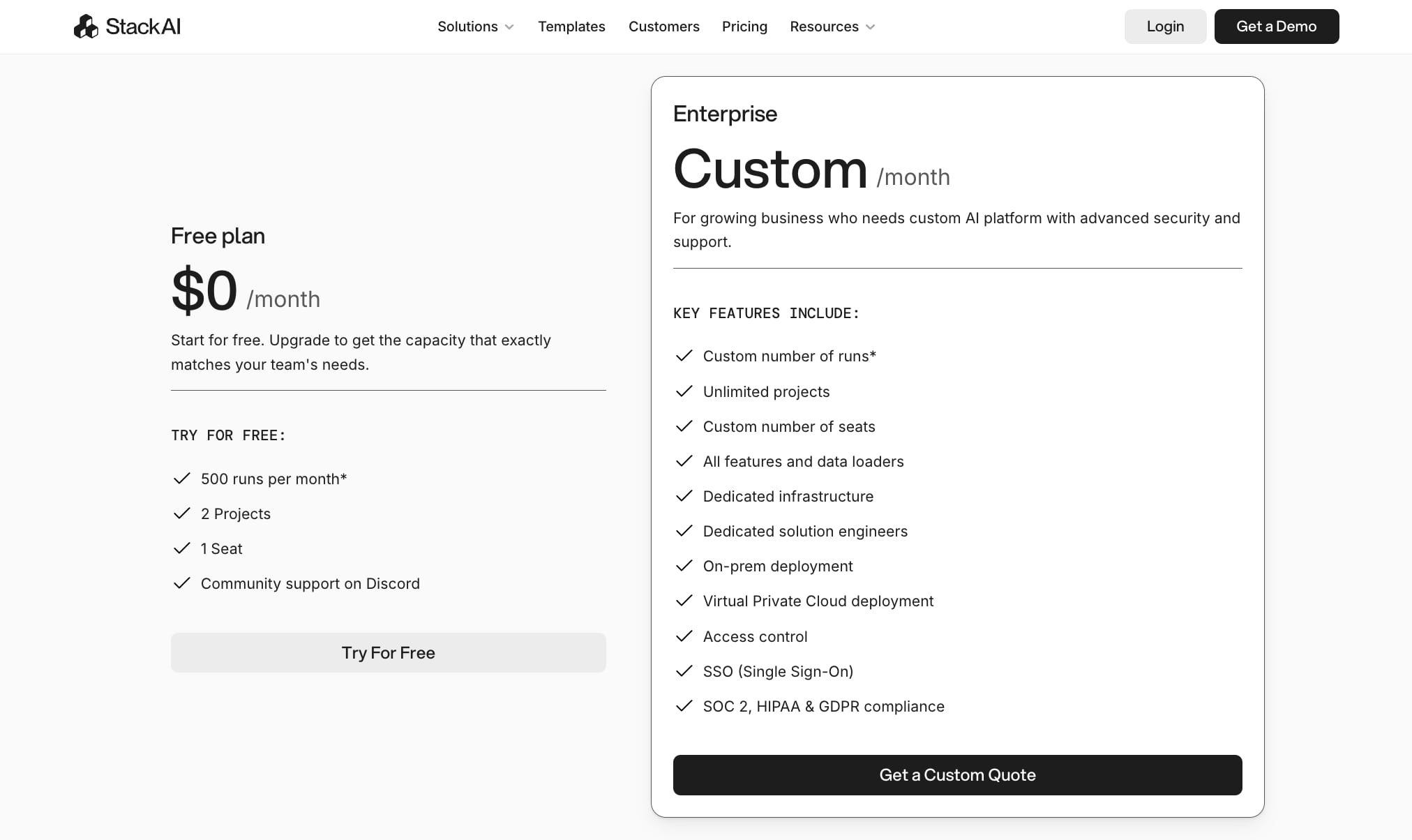
Here are StackAI's pricing plans:
- Free is $0/month with 500 runs per month, 2 projects, 1 seat, and Discord community support
- Enterprise is custom pricing with unlimited projects, custom runs and seats, on-prem deployment, VPC deployment, SSO, and SOC 2, HIPAA, and GDPR compliance
You can learn more about what each plan includes on their pricing page.
StackAI reviews and ratings
Here's what others say about StackAI on third-party review sites:
- G2: 4.5/5 star rating (from +38 user reviews)
- Slashdot: 4.4/5 star rating (from +9 user reviews)
3. Workato
- Best for: Large enterprises that want to turn their existing iPaaS into an MCP layer for agents
- Pricing: Custom pricing based on platform edition and usage
- What I like: Built on the #1 iPaaS, so the integration depth is hard to match
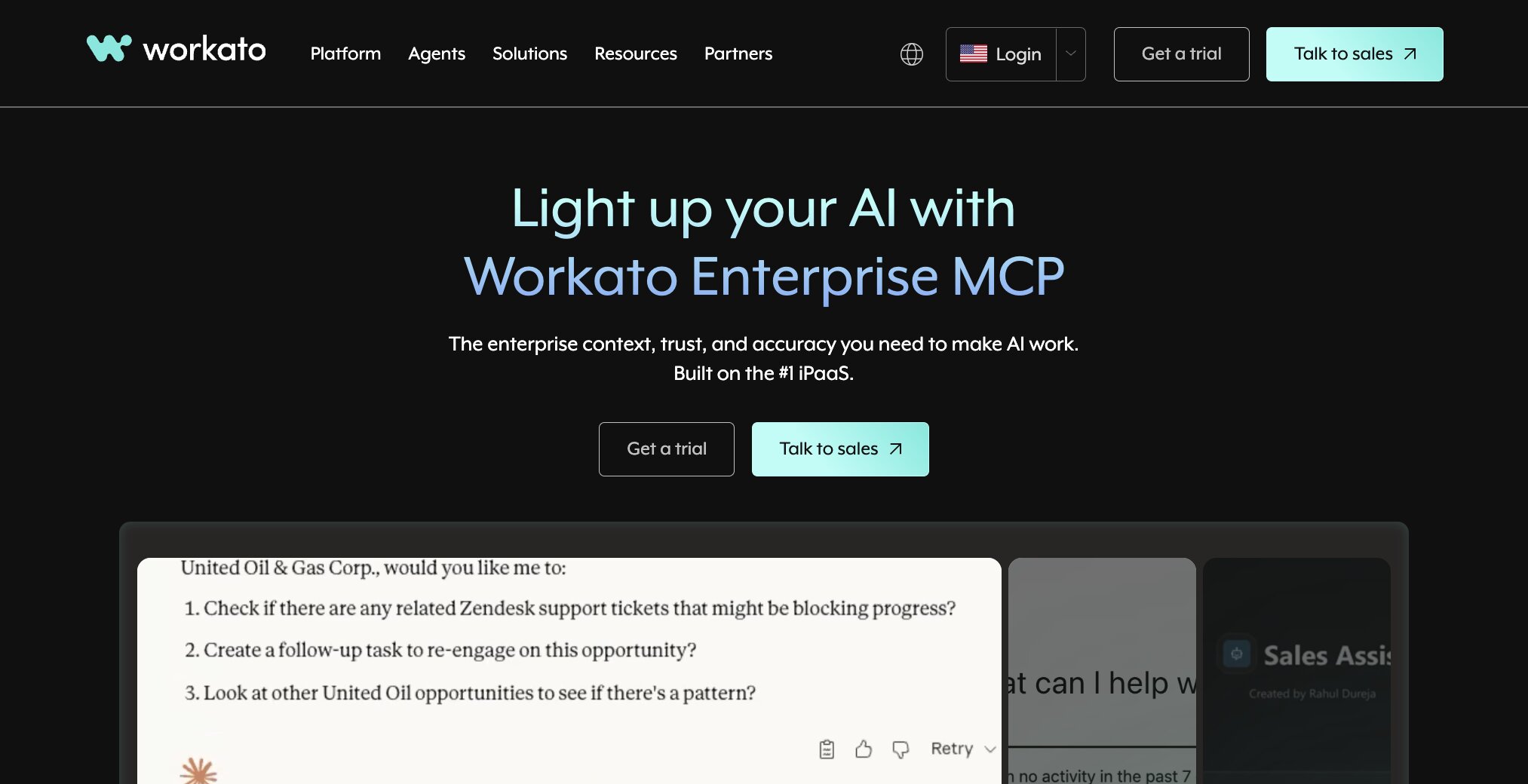
Workato is an enterprise agentic platform that has started to focus more on creating an MCP layer between your tools. What this means is that Workato acts as a layer between LLMs and your tool calls.
So for example, if you have a sales team using ChatGPT or Claude, Workato sits between those LLMs and your Salesforce, NetSuite, Workday, or ServiceNow data. The LLM sends a request, Workato handles the authentication, governance, and data orchestration, and then passes the result back. It basically turns every tool in your stack into something your agents can safely use.
Workato started as an iPaaS (integration platform as a service) and has been around for over a decade. So the integration depth is one of the strongest on this list. They also have a product called Agent Studio for building agents, and a library of pre-built "Genies" for specific functions like IT, HR, sales, support, and marketing.
Some things I like about Workato:
- The Enterprise MCP Gateway reminds me of Gumloop's guMCP, and is one of the more mature approaches I have seen for connecting LLMs to enterprise tools in a governed way
- It has been recognized as a Leader in the Gartner Magic Quadrant for iPaaS eight times, which tells you a lot about the stability of the platform
- The pre-built Genies for IT, sales, HR, and support give larger teams a faster way to roll out agents without starting from scratch
- Integrates deeply with enterprise systems of record like Salesforce, NetSuite, Workday, and ServiceNow
Some things I do not like about Workato:
- Pricing is not transparent and is based on custom consumption models, so you will not know what you are paying until you talk to sales
- The learning curve and setup time is steeper than newer AI-native platforms because a lot of the product is rooted in traditional iPaaS concepts
Overall, Workato is a strong pick for large enterprises that already rely on an iPaaS and want to extend it into an agentic layer. If you are a smaller team that just wants to build AI agents right away, it might be worth looking into a simpler alternative.
Workato pricing
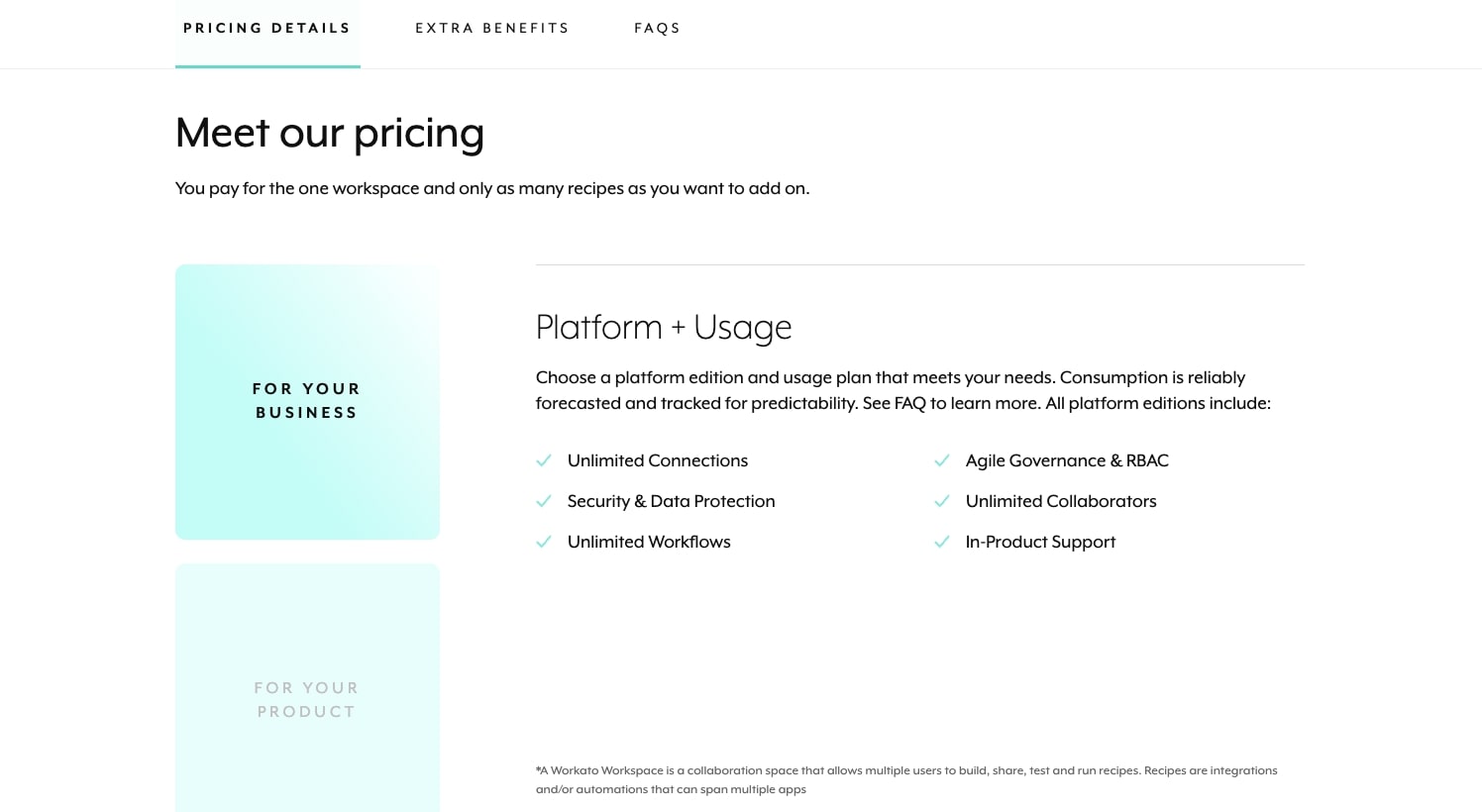
Workato does not publicly list their pricing. Plans are based on a platform edition plus a usage plan, and every edition includes unlimited connections, unlimited workflows, unlimited collaborators, role-based access control, and in-product support.
You can learn more about their pricing structure on their pricing page.
Workato reviews and ratings
Here's what others say about Workato on third-party review sites:
- G2: 4.7/5 star rating (from +752 user reviews)
- Gartner Peer Insights: 4.9/5 star rating (from +559 user reviews)
4. LangChain
- Best for: Engineering teams that want full control over how their agents are built, evaluated, and deployed
- Pricing: Free Developer plan, Plus starts at $39/seat per month, Enterprise is custom
- What I like: The observability and evaluation tools are some of the most mature in the space
LangChain is a framework for building and deploying AI agents. It is a more technical tool compared to the others we have gone over so far, mainly because it is built primarily for engineering teams that want to code their agents from scratch rather than use a GUI builder.
The company has expanded into a full commercial platform called LangSmith, which can now take care of observability, evaluation, and deployment for agents built on any framework. They also recently launched Fleet, which is their take on company-wide agents that non-engineers can use for recurring tasks like research, follow-ups, and status checks (this is very similar to Glean — the last tool on this list).
LangChain is trusted by some pretty big companies like Klarna, Coinbase, Rippling, Cloudflare, and more. So it's built for some serious use.
Some things I like about LangChain:
- The tracing and observability tools make it way easier to debug agents that have long, branching logic
- LangSmith can support evaluation workflows like LLM-as-judge, human feedback scoring, and regression testing, which is rare to see in one platform
- It works across Python, TypeScript, Go, and Java, so engineering teams can pick it up in whatever language they already use
- Native support for MCP and A2A (agent-to-agent) protocols, which matters if you are building multi-agent systems
Some things I do not like about LangChain:
- It is built for engineers, so non-technical team members will struggle to contribute directly to how agents are built (can be tough for teams that want to move fast)
- Pricing has a lot of moving pieces (base traces, deployment runs, uptime cost, Fleet runs), which can make it harder to forecast what you will actually spend
- The open source frameworks (langchain, langgraph, deepagents) have a learning curve that can slow teams down before they ship anything of true value
Overall, LangChain is the pick for enterprise engineering teams that want to own their agent stack end-to-end. It adds complexity to the whole "build your own agent" thing, but I can see how some companies actually prefer that (which is why I included it in this list). Otherwise, if you want a more friendly AI agent builder, it might be worth looking into an alternative.
LangChain pricing
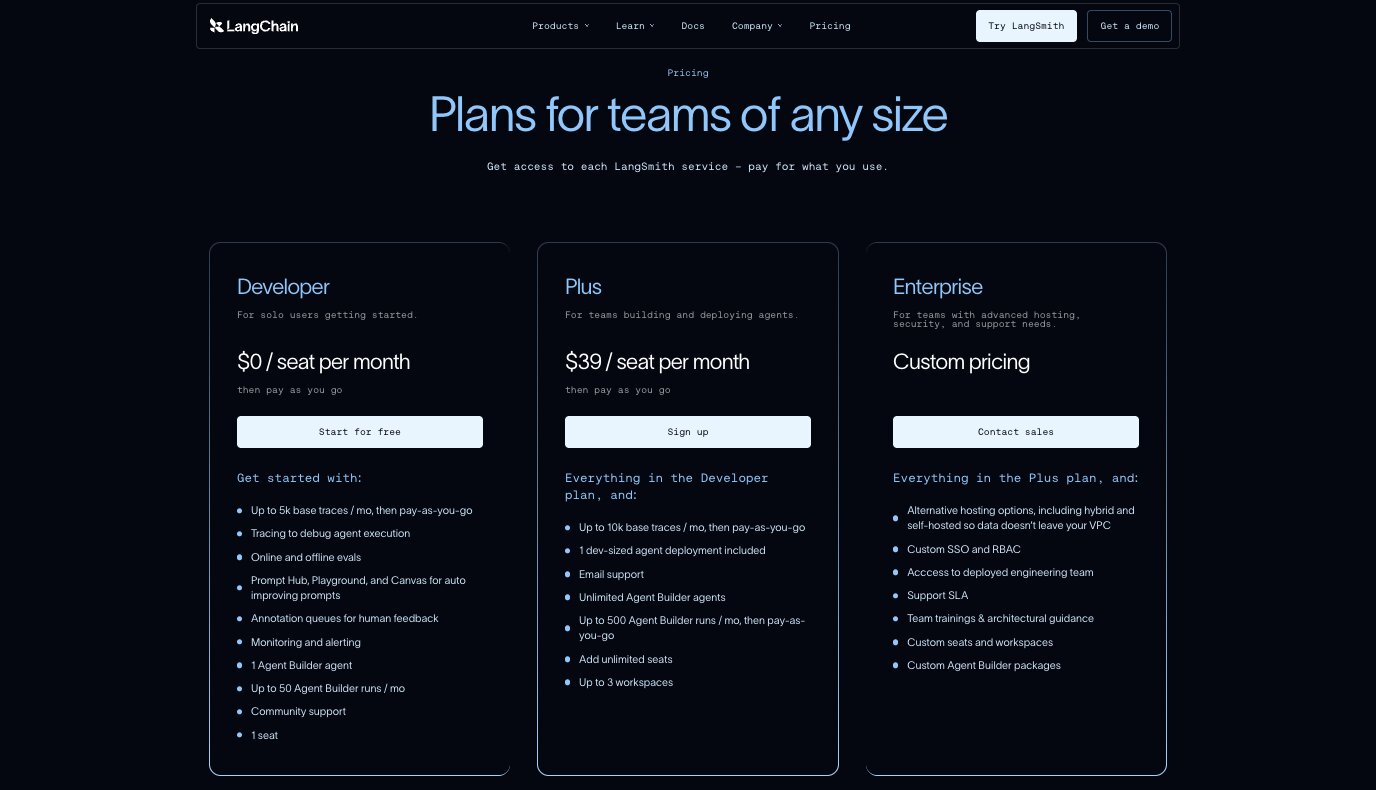
Here are LangChain's pricing plans for LangSmith:
- Developer is $0/seat per month with 5k base traces per month, tracing, evals, monitoring, and 1 Fleet agent
- Plus is $39/seat per month with 10k base traces, unlimited Fleet agents, up to 500 Fleet runs per month, and 1 dev-sized deployment included
- Enterprise is custom pricing with hybrid or self-hosted deployment, custom SSO and RBAC, support SLAs, and dedicated engineering access
You can learn more about what each plan includes on their pricing page.
LangChain reviews and ratings
Here's what others say about LangChain on third-party review sites:
- G2: 4.7/5 star rating (from +39 user reviews)
- GitHub: 135k+ stars and one of the most widely adopted LLM frameworks
5. Glean
- Best for: Enterprises that want employees to easily find and make sense of their company knowledge and tools
- Pricing: Not publicly listed, demo required
- What I like: Feels like a ChatGPT that actually knows everything in your business
Glean is an AI search and agent assistant built for enterprises that want to help their employees easily find and make sense of their company knowledge base and tools.
It feels more like an assistant that has access to your entire tech stack and can answer any question team members may have. Think of it like a ChatGPT chatbot that knows everything in your business. It indexes content across 100+ apps like Slack, Google Drive, Confluence, Salesforce, Jira, GitHub, and Notion, and then uses that context to answer questions or surface the right document.
Historically, Glean has been more focused on reading tools and relaying information back to users rather than executing tasks across your stack. But they have expanded into agents recently with Glean Agents, which includes an Agent Builder, Agent Orchestration, and a prebuilt Agent Library. So the platform has evolved into something that can both retrieve information and take action on it.
Glean is used by some huge companies in tech like, including Webflow, Grammarly, Zapier (ironic), Pinterest, and more.
Some things I like about Glean:
- The search experience is great for enterprise knowledge, and it actually understands context across different tools
- Glean connects to over 100 apps, so it can pull context from pretty much anywhere your company stores information
- The permissions model is strict, which means your employees only see what they are allowed to access in your connected tech stack
Some things I do not like about Glean:
- Its better at reading tools and relaying information, than being a full agentic platform
- Pricing is not public, so you have to book a demo to even get a quote
- The agent-building side of the product is newer, so if you are looking for a mature agent builder to write and execute tasks across your stack, Gumloop or LangChain will likely be a better fit
Overall, Glean is the pick if your main goal is giving employees a single place to find and understand information across your entire tech stack. If you are looking for an agent that can take action on tasks across your tools, there are stronger options on this list.
Glean pricing
Glean does not publicly list their pricing. You will need to book a demo with their sales team to get a custom quote based on your company's needs.
Glean reviews and ratings
Here's what others say about Glean on third-party review sites:
- G2: 4.7/5 star rating (from +152 user reviews)
- Gartner Peer Insights: 4.4/5 star rating (from +121 user reviews)
What is the best enterprise AI agent tool?
Out of all the tools I've used, I truly believe the best enterprise AI agent tool is Gumloop. At least for most people.
It handles the full range of what you need from an enterprise AI platform. Agentic AI that can work alongside your team, multi-agent systems that can run in the background, and a real security and compliance layer through Gumstack that IT departments can actually monitor.
You also get workflow automation, human-in-the-loop controls at every decision point, and the flexibility to build autonomous agents that plug into your large language models of choice. It is genuinely hard to find another platform that does all of that in one place.
That said, there are two cases where I would point you somewhere else.
If you work in a heavily regulated industry like finance, healthcare, legal, or insurance, StackAI is worth looking at. Their on-prem and virtual private cloud deployment options make it easier to handle data privacy requirements that a lot of other platforms cannot meet. And their retrieval augmented generation setup through knowledge bases is solid for document-heavy workflows.
If you have a dedicated engineering team with real resources and time to invest, LangChain is the pick for fully custom builds. It will give you the deepest control over how your agents reason, what tools they call in real-time, and how you handle decision-making and evals across your generative AI stack. Just know that scalability and maintenance fall on your team, not on the vendor.
For everyone else, Gumloop is where I would start. Going back to my cohort retention analysis story at the start of this article, that kind of "how did I ever live without this" moment is exactly what Gumloop unlocked for the rest of my team. And the best part is our security team has full visibility into usage, access controls, and observability that enterprise companies need to become AI-native.
Now go out there and empower your team. They need you.

Read related articles
Check out more articles on the Gumloop blog.