

6 lead enrichment tools (and how to automate them) in 2026

Over 10 years ago, I was a marketing intern at a startup trying to close enterprise deals.
My process was as manual as it gets. I used LinkedIn Sales Navigator to find decision makers, ZoomInfo to grab emails, and then wrote outreach emails one by one trying to book sales calls.
I’d gather and send emails to maybe 20 to 30 leads a day if I was locked in. And a lot of the emails would bounce or I would get a nasty reply (ouch).
Today, lead enrichment tools can do in minutes what it used to take me a full day to do. And they're able to find higher quality contacts so you're not wasting time emailing people who left a company six months ago.
In this article, I'm going over the best lead enrichment platforms I've tested and trust, including what each one is best for, pricing, and how they compare.
I’ll also go over a tool that can help you merge data sources from different tools and help you run automations that automatically enrich leads and draft emails.
Alright, let’s get started.
What is a lead enrichment tool?
A lead enrichment tool is a platform that takes your existing lead data and fills in the gaps with extra contact and company information. So if you already have a list of names or email addresses, an enrichment tool can add things like job titles, company size, revenue, industry, LinkedIn profiles, phone numbers, and etc.
These tools generally pull from large databases of customer data that are constantly being updated from sources across the web. Some platforms aggregate data from public records, social media profiles, and company filings. Others use AI to scrape and verify information in real time (which I’ll go over later).
The main goal of a tool like this is to help you figure out who is worth reaching out to, and when. So the way you get there is by having the right information about each contact to see if it matches your ICP.
And really, you also want a tool that can combine enrichment data with buyer intent signals. Some of the tools on this list can tell you not just who a lead is, but whether they're actively looking for a solution like yours. That turns your lead generation efforts it something that is actually useful with strong signal.
Okay, now let me go over how I chose some of these tools on this list. I’ve been familiar with these types of tools since my first marketing internship well over 10 years ago, so I know they’re not all built the same.
How I chose the best lead enrichment tools
When putting this list together, I wanted to make sure each tool actually earned its spot. There are a lot of enrichment platforms out there right now, and not all of them are worth your time or money.
Here are the main things I looked at when evaluating each tool:
- Data accuracy and freshness: How reliable is the contact and company data? Is it being updated regularly, or are you getting outdated emails and job titles from five years ago?
- Coverage: Does the platform cover enough contacts and companies for your target market? Some tools are strong in the US and Canada but weak internationally, and vice versa.
- Enrichment depth: How many data points do you actually get back per record? Things like job title, company size, revenue, tech stack, LinkedIn profile, and funding data all matter depending on your use case.
- Ease of integration: Can you plug the tool into your existing CRM, spreadsheets, or automation stack without needing an engineer to set it up?
- Buyer intent signals: Does the platform go beyond static data and tell you whether a lead is actively in-market for a solution like yours?
- Who it's actually built for: Some tools are designed for enterprise sales teams with big budgets. Others are built for solo founders or small teams. I wanted to include a mix so there's something useful no matter what stage you're at.
Not every tool on this list checks every single box. But each one is strong in at least a few of these areas, and I made sure to call out where each tool shines and where it falls short.
Okay, let's get into the list.
6 best lead enrichment tools for 2026
Here are the best lead enrichment tools:
- Apollo
- ZoomInfo
- Clearbit (now HubSpot)
- Enrich Layer
- SimilarWeb
- Gumloop
Let's take a deeper look at each one.
1. Apollo
- Best for: Sales teams that want enrichment and outbound in one platform
- Pricing: Free plan available, paid plans start at $59/month
- What I like: One of the largest lead databases out there, and a lot of other sales tools actually use Apollo's data under the hood
Apollo is an AI sales platform that is designed to help you do everything from outbound marketing to data enrichment and deal execution.
But what really makes Apollo great is that it's a data enrichment platform at its core. And many of its features like the outbound or inbound features are built around that core concept. So Apollo gives you a full platform to always have fresh lead data.
I like Apollo because it has one of the largest lead databases out of any platform. And a lot of other sales engagement tools actually use Apollo's data in their tooling. So it's like going straight to the source of having accurate data.
Here are some things I like about Apollo:
- It has a database of over 210M+ contacts and 65 plus data points
- Has waterfall enrichment features to help you expand on your data coverage
- Has built-in AI agents for doing external research to enrich data past its internal database
- Has AI-powered lead scoring based on any criteria you set
Here are some things that could be improved:
- Some of the email and phone data can be outdated, especially when certain leads leave job positions and their company email address changes
- While it is a powerful platform, the UI/UX can have a learning curve to set everything up
- There are limits when you're trying to export a large amount of data from the platform
Overall, Apollo is a great lead enrichment tool and I highly recommend it as a source of data to help inform your outbound efforts. The great thing about Apollo is that you can integrate it with other automation tools to get even more power from it, which I'll explain more in the last tool we go over.
Apollo pricing
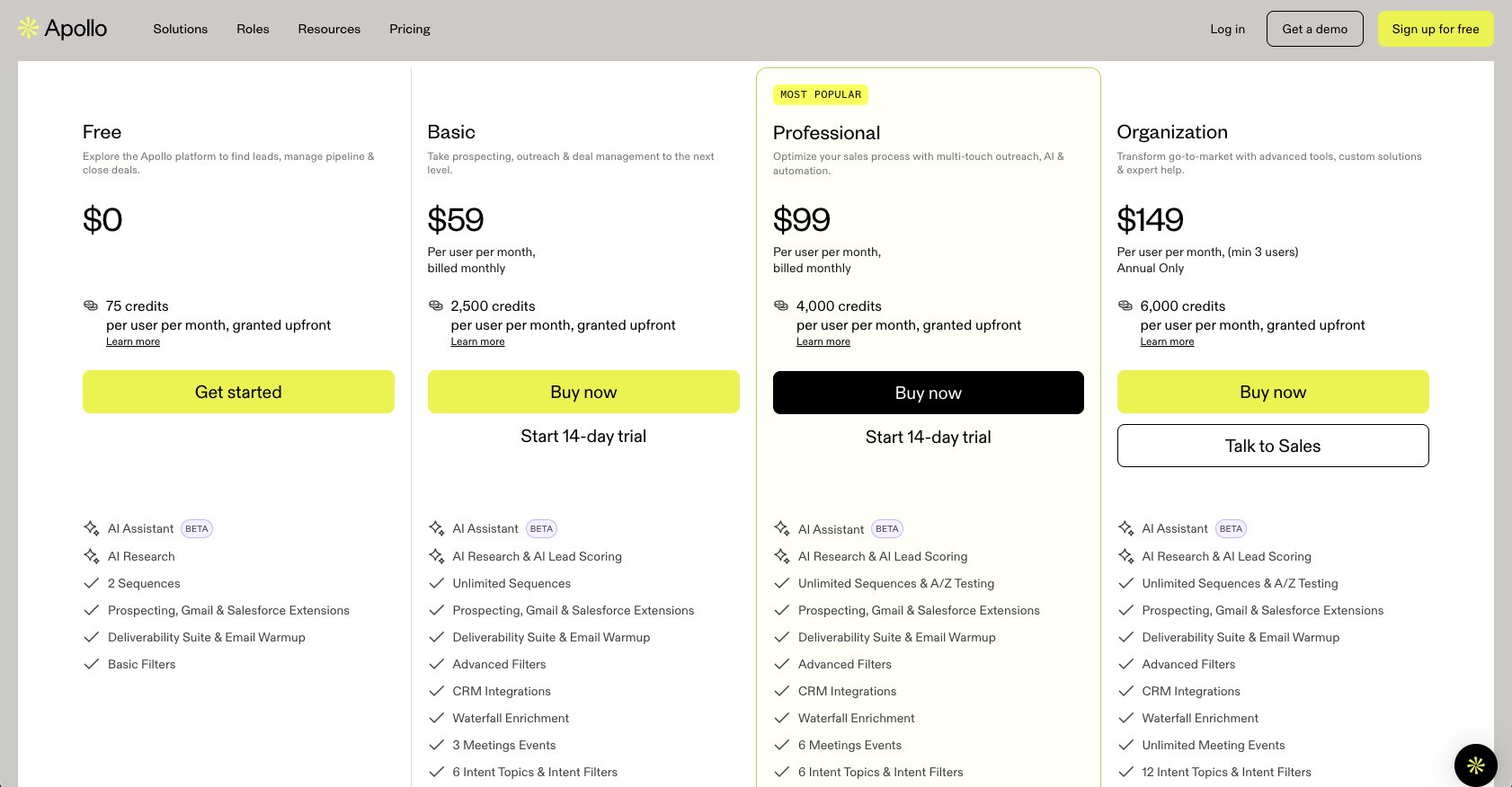
Here are Apollo's pricing plans:
- Free: $0/month with 75 credits/user/month, AI assistant, 2 sequences, basic filters
- Basic: $59/user/month with 2,500 credits/user/month, unlimited sequences, waterfall enrichment, intent filters
- Professional: $99/user/month with 4,000 credits/user/month, automated workflows, call recordings, A/Z testing
- Organization: $149/user/month (min 3 users, annual only) with 6,000 credits/user/month, customizable reports, SSO, advanced security
You can learn more about what each plan includes on their pricing page.
Apollo reviews
Here's what customers of Apollo rate the tool on third-party websites:
- G2: 4.7 out of 5 star rating (from +9,407 user reviews)
- Capterra: 4.5 out of 5 star rating (from +384 user reviews)
2. ZoomInfo
- Best for: Enterprise B2B teams that need deep contact and company intelligence
- Pricing: Custom pricing (contact sales)
- What I like: One of the largest B2B contact databases with data aggregated from multiple sources, which keeps quality high
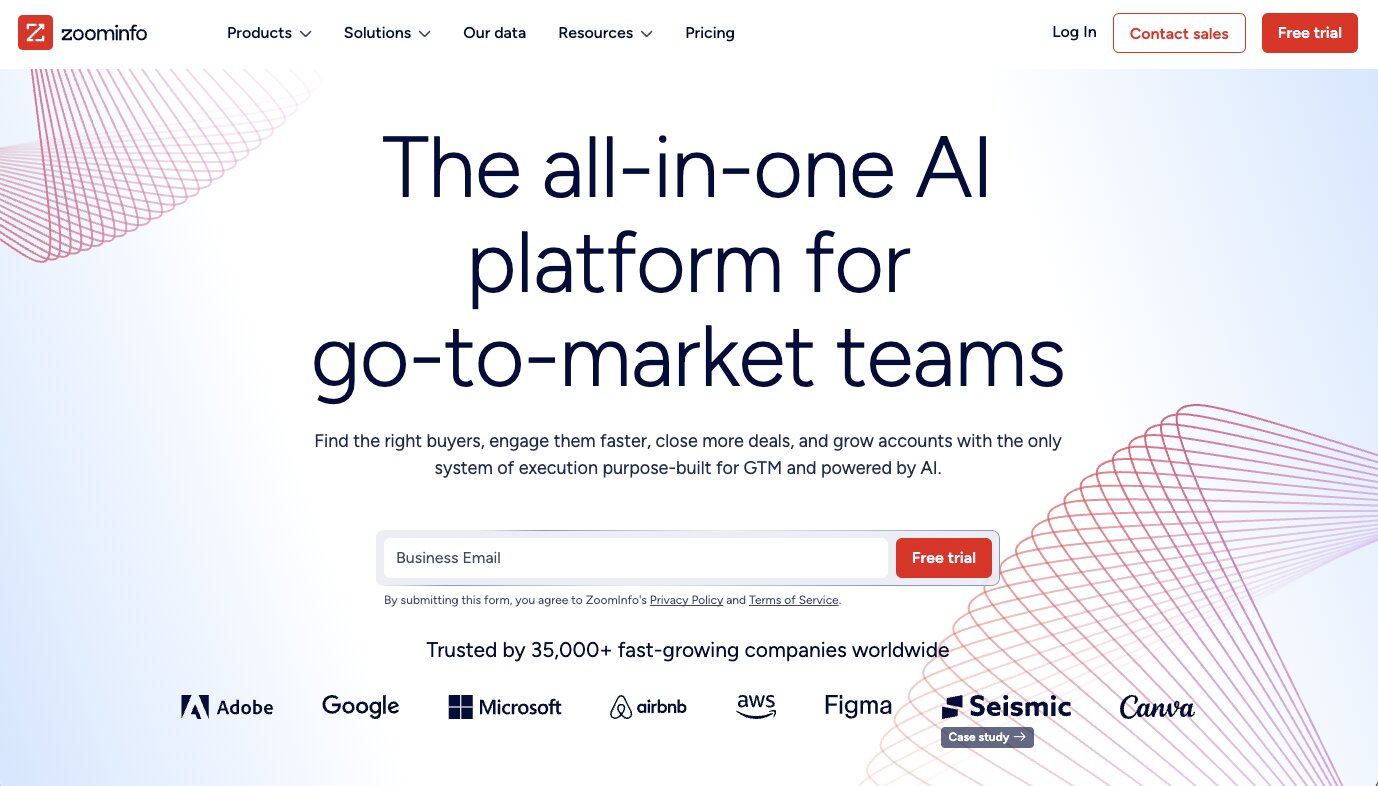
ZoomInfo is a data platform specifically for B2B companies. It helps GTM teams across sales, marketing, or even recruiting. It's basically a data source any business can tap into when they need to find information about employees at other companies.
ZoomInfo works by aggregating information like company info, org charts, emails, and intent signals, and places them all into one platform you can search through. Think of it like the Google for contact information.
You can filter by firmographics like industry, company size, location, job roles, and tech stack use, and export those contacts or sync them into a CRM or outreach tool.
Here are some things I like about ZoomInfo:
- Has over 200M+ contacts of people and companies with a strong focus on US/CA and mid-market/enterprise businesses
- Because the contact data is aggregated from multiple places, the quality seems to be on the higher side (as there are more inputs)
- If you're an enterprise company, it has native integrations with platforms like Salesforce, HubSpot, and other CRMs
- Its advanced search features make it easy for recruiting, marketing, or SDR teams to build targeted lead lists
Here are some things that could be improved:
- This is very much an enterprise tool, so pricing is really high and it's not that accessible for small startups
- Just like some other platforms, the contact data can become outdated over time
- Because it is an enterprise tool, it can feel a bit overwhelming and complex for simple use cases
Overall, if you're a large company and you're looking for an enterprise solution for lead enrichment, then ZoomInfo is definitely a trusted platform to check out. However, if you are more of a lean startup, then it might be worth using Apollo or tools four and six on this list.
ZoomInfo pricing
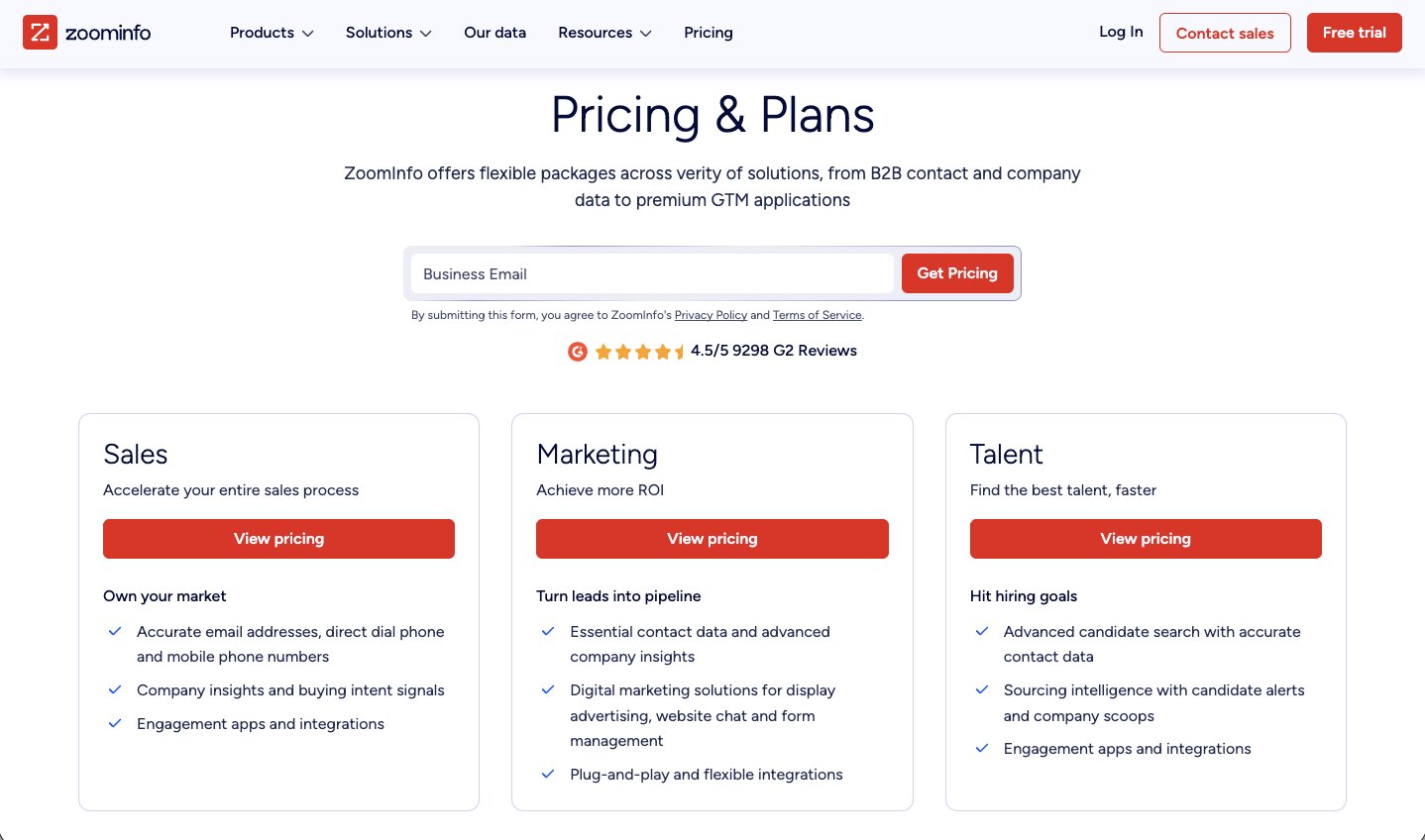
ZoomInfo offers three main products, each with custom pricing:
- Sales: Accurate contact data, buying intent signals, and engagement apps for sales teams
- Marketing: Advanced company insights, digital advertising solutions, and flexible integrations for marketing teams
- Talent: Advanced candidate search with accurate contact data and sourcing intelligence for recruiting teams
All plans require you to contact their sales team for pricing. You can learn more on their pricing page.
ZoomInfo reviews
Here's what customers of ZoomInfo rate the tool on third-party websites:
- G2: 4.5 out of 5 star rating (from +8,996 user reviews)
- Capterra: 4.1 out of 5 star rating (from +316 user reviews)
3. Clearbit (now HubSpot)
- Best for: B2B companies that want real-time visitor identification and data enrichment
- Pricing: Contact sales for pricing
- What I like: One of the highest quality data sources out there, especially for identifying which companies are visiting your website in real time
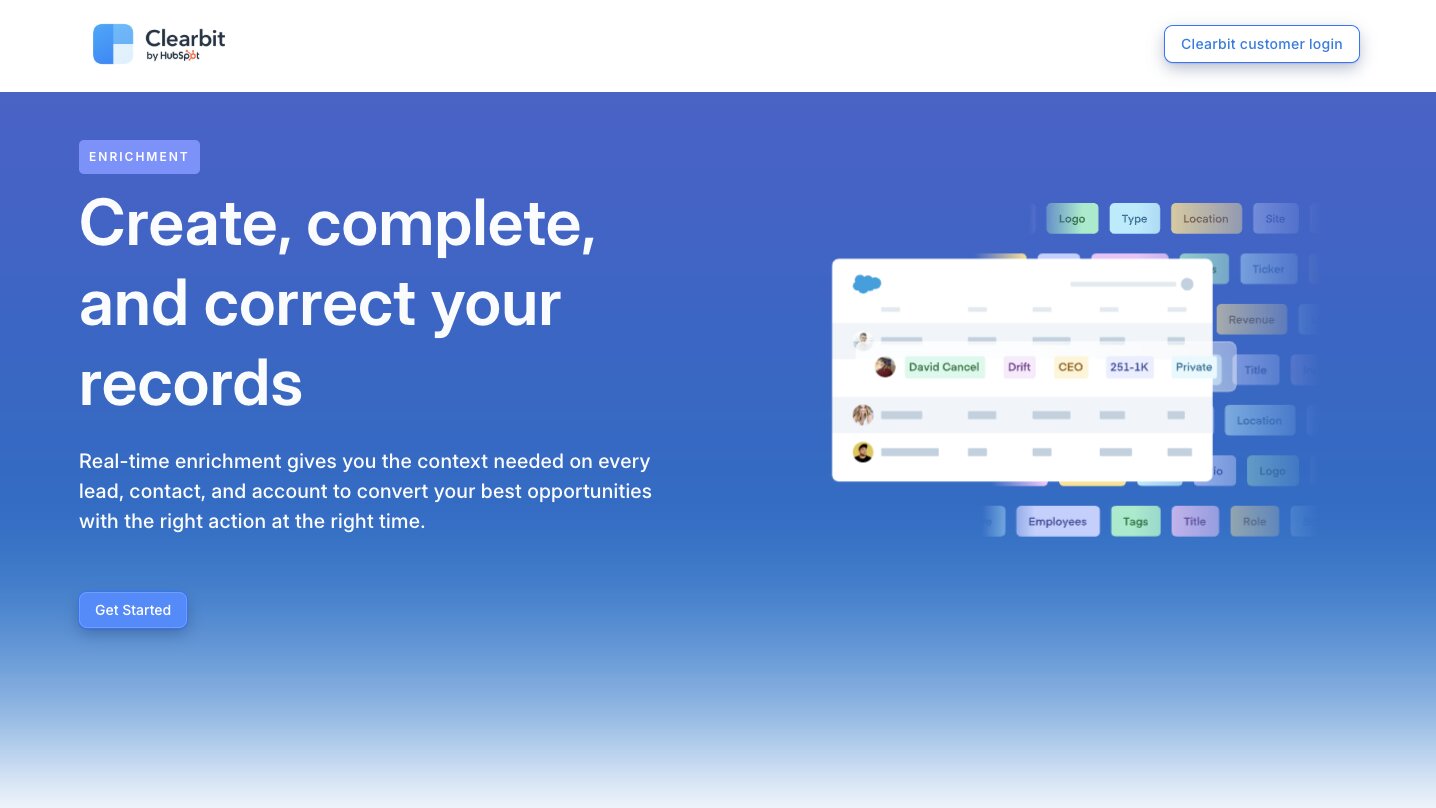
Clearbit (now a part of HubSpot) is a B2B data enrichment platform that can integrate with your existing CRMs and tools to figure out information on companies in real time.
Now let me explain that without the jargon. Clearbit is actually one of my favorite enrichment tools out there, and before they were acquired by HubSpot, I mostly used the platform to figure out which companies were landing on my website.
So the tool lets you see which employees at what companies are interacting with your business, and then from that data you can actually personalize experiences for them. For example, when I used to work at Webflow, one day I was visiting another B2B SaaS website and on their homepage it showed the Webflow logo. And it blew my mind because it knew that I was browsing while being logged into my email. And because it showed the logo of the company I worked at, it made it feel super personalized to me.
So the platform works by ingesting data from hundreds of public and private data sources like the web, social media, legal filings, and proprietary data, and it uses machine learning to standardize attributes like employee count, revenue, tech stack, job seniority, and more.
But now that it's a part of HubSpot, it acts more like a native data layer inside the HubSpot ecosystem. So if you are using HubSpot, then you have access to the enrichment features that Clearbit offers.
Here are some things I like about Clearbit:
- It has real-time enrichment and it's really good at instantly understanding what companies your website visitors work at
- Compared to some other data enrichment platforms, it is known to have one of the highest quality data accuracy
- It works great with external tools like Salesforce or other marketing automation tools, so it's easy to attach it to your existing tech stack
Here are some things that could be improved:
- It's an amazing and high quality platform, but with that comes a premium price tag that might be out of range for smaller businesses
- It's mostly good for businesses that already get a lot of inbound and they want to enrich their existing data
- It requires some technical setup, so you will need engineering help
Overall, Clearbit is an amazing platform for enriching data to the point where you can personalize experiences for your target customers. But because of this premium quality, it is quite expensive compared to some other tools in this space.
Clearbit pricing
Clearbit does not publicly list its pricing. Because it's now part of HubSpot, pricing depends on your HubSpot plan and usage. You can learn more by contacting their sales team.
Clearbit reviews
Here's what customers of Clearbit rate the tool on third-party websites:
- G2: 4.5 out of 5 star rating (from +628 user reviews)
- ProductHunt: 4.5 out of 5 star rating (from +8 user reviews)
4. Enrich Layer
- Best for: Developer-friendly enrichment via API with broad people and company data
- Pricing: Starts at $49/month, with annual plans available
- What I like: It's a pure data layer that gives you access to people, company, and job data through one unified API
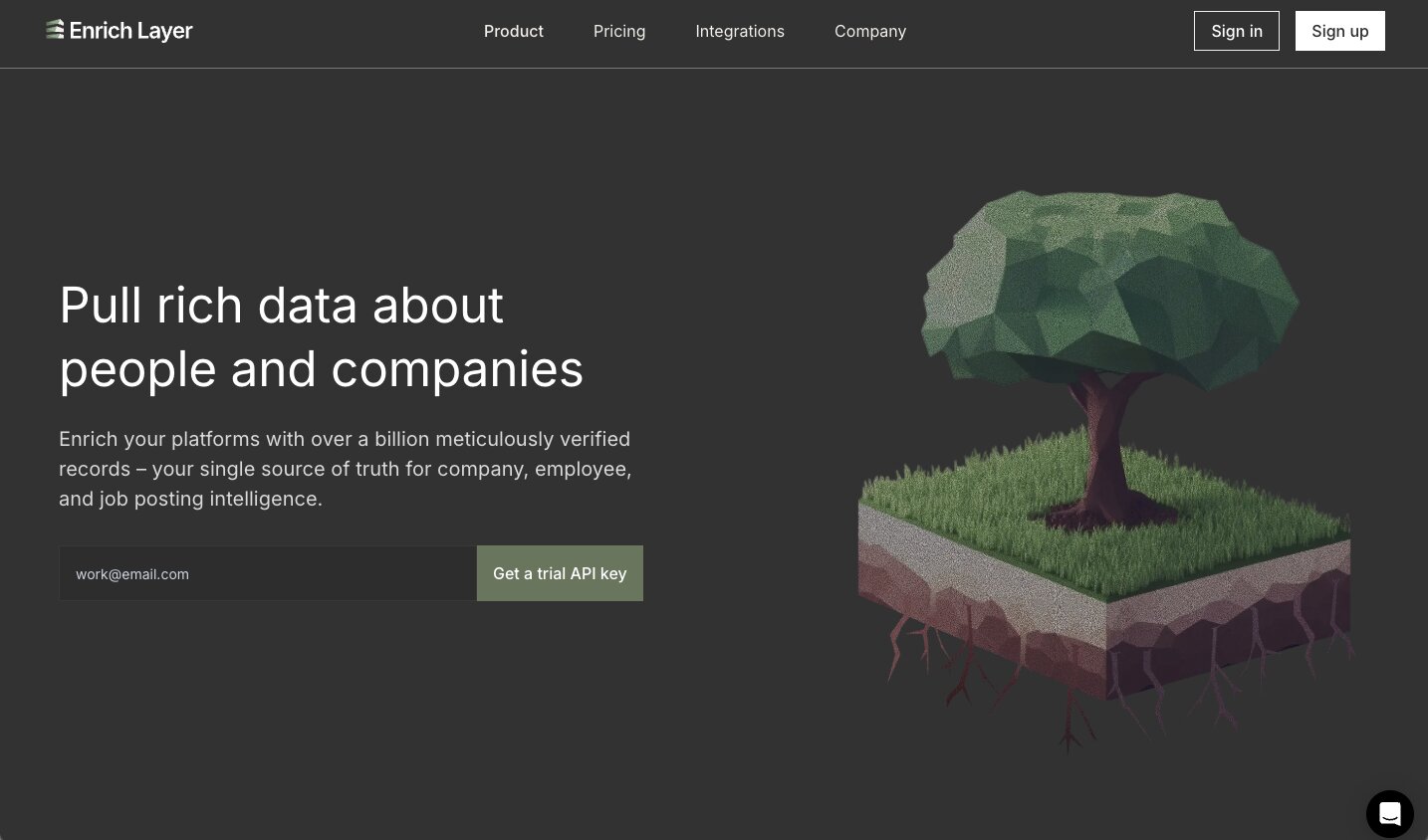
Enrich Layer is a B2B data enrichment platform that gives you access to people, company, and job posting data through a single API. Instead of building a full sales engagement platform around the data (like Apollo does), Enrich Layer focuses purely on being the data source itself.
The platform pulls from multiple curated data sources and merges everything into clean, standardized fields. So you query it with something like an email address, a domain, or a company name, and you get back structured data like job titles, work history, company size, revenue, industry, funding info, and more.
They also have over 790M+ global people records and over 70M+ companies, with 60+ data points per record.
What makes Enrich Layer interesting is that it's built with developers in mind. If you're the kind of team that wants to pipe enrichment data directly into your own product, CRM, Claude Code, or internal tools through an API, this is built for that. It supports bulk operations, webhooks, and integrations with automation platforms, so you can plug it into whatever stack you're already running.
And if you want to use the data with an easy to use interface, then you can paid it up with an automation platform like Gumloop (which we’ll get into later).
Here are some things I like about Enrich Layer:
- One API that covers people, companies, and job data all in one place
- Broad data coverage with 790M+ global people records and 70M+ companies
- Developer-friendly design with REST API, bulk endpoints, and webhook support
- The option to choose data freshness levels based on your needs
- Works with automation platforms so you can push enriched data into CRMs, spreadsheets, or internal tools
Here are some things that could be improved:
- It's purely a data layer, so you'll still need separate tools for outreach, sequencing, and sales engagement
- Getting full value requires some technical setup, so if you don't have a developer on your team it might not be the best fit
- It's a newer platform, so there aren't a ton of public customer reviews compared to bigger players like Apollo or ZoomInfo
- Pricing is credit-based and can require some math to figure out your actual cost depending on which API endpoints you're using
Overall, Enrich Layer is a solid option if you're a technical team that wants clean, flexible enrichment data piped directly into your own systems. It's not trying to be an all-in-one sales platform, and that;s actually what I like about it.
If you just want access to clean data for enrichment purposes, and you’re tech savvy enough to pair this up with a tool like Claude Code, Salesforce, or Gumloop, then this platform is it.
Enrich Layer pricing
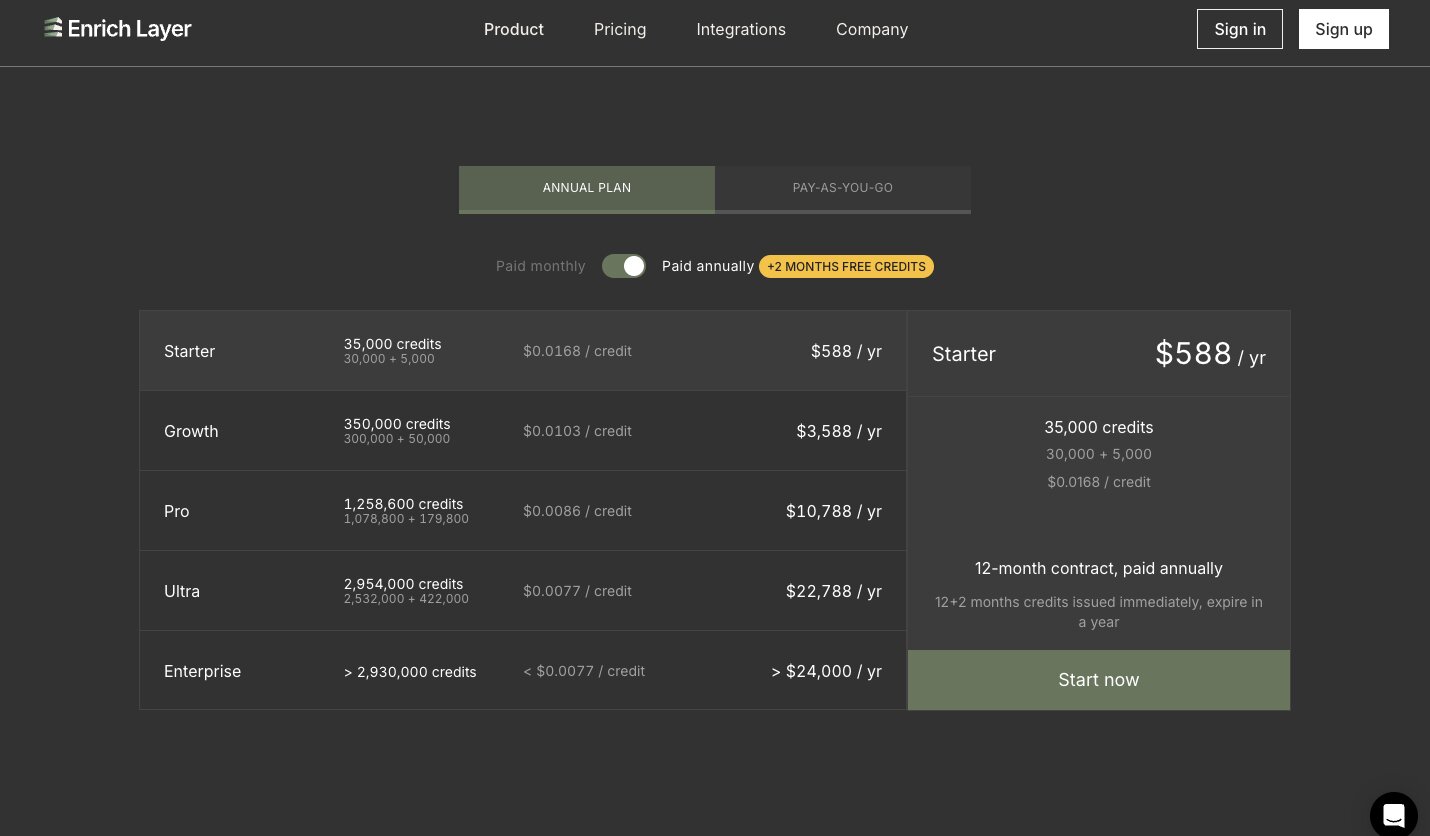
Here are Enrich Layer's monthly pricing plans:
- Starter: $49/month with 2,500 credits, $0.0196/credit
- Growth: $299/month with 25,000 credits, $0.0120/credit
- Pro: $899/month with 89,900 credits, $0.0100/credit
- Ultra: $1,899/month with 211,000 credits, $0.0090/credit
- Enterprise: Custom pricing for 211,000+ credits at less than $0.0090/credit
Annual plans are also available with discounted rates and bonus credits. You can learn more about what each plan includes on their pricing page.
Enrich Layer reviews
There are currently no public reviews on third-party sites for Enrich Layer.
5. SimilarWeb
- Best for: Enriching leads with company-level digital intelligence like web traffic, growth signals, and competitive data
- Pricing: Free plan available, paid plans require contacting sales
- What I like: Gives you a layer of enrichment data that traditional contact databases simply don't have
SimilarWeb holds a special place for me because it was actually the first marketing tool I ever used when I started my career. And it's still one of my favorites to this day.
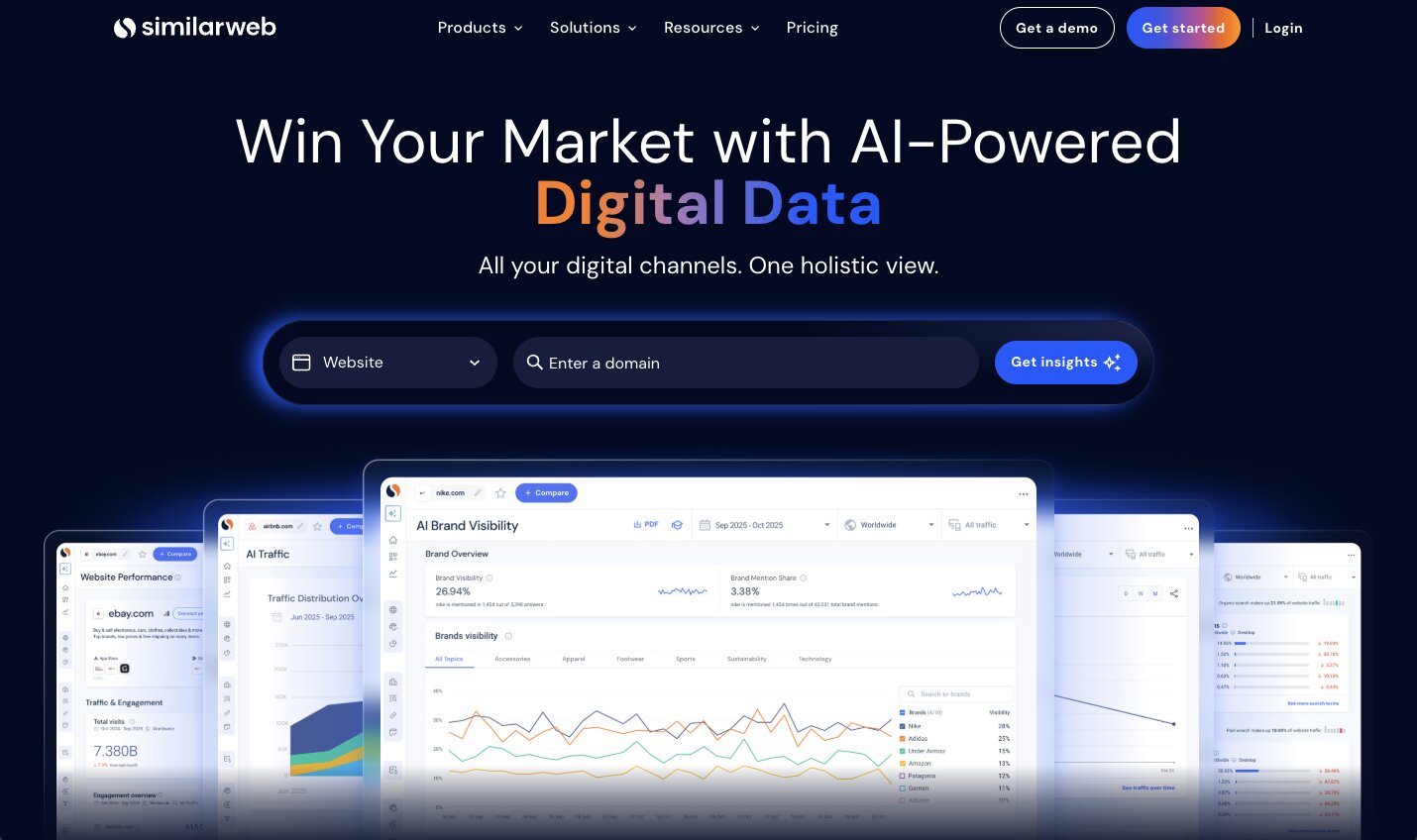
Now, SimilarWeb is a bit different from the other tools on this list. It's not a traditional lead enrichment platform that gives you emails and phone numbers. Instead, it's a digital intelligence platform that lets you see estimated traffic, engagement metrics, traffic sources, and competitive data for almost any website or app.
So why is it on a lead enrichment list? Because the data it provides is incredibly useful for qualifying and scoring leads. When you're doing outbound or evaluating inbound leads, knowing how much traffic a prospect's website gets, where that traffic comes from, what tech stack they're using, and whether they're growing or shrinking is a huge advantage. It's a layer of enrichment that tools like Apollo or ZoomInfo don't give you.
The platform collects anonymized behavioral data from multiple sources like browser extensions, ISP partnerships, and public data, and then uses models to estimate visits, sources, and engagement for websites and apps. You can enter any site and instantly see traffic volume, geography, channel breakdowns (organic, paid, social, referrals), top pages, keywords, and then benchmark that site against competitors.
SimilarWeb also recently added Gen AI visibility features, so you can now see how much traffic sites are getting from AI tools. Which is pretty cool given how fast that space is growing.
Here are some things I like about SimilarWeb:
- Gives you competitive and market intelligence that you can't get from traditional contact enrichment tools
- Has detailed channel-level breakdowns including organic search, paid search, social, referrals, display, and affiliates
- The SEO and SEM features are solid for keyword research, rank tracking, and seeing what competitors are bidding on
- Has a free tier and a browser extension, so you can get useful data without committing to an enterprise contract
- Claims to cover 100M+ websites, 20M+ companies, and 5B+ search terms in their data repository
Here are some things that could be improved:
- The data is estimated and not first-party, so smaller sites or niche markets will be based on educated guesses and not actual analytics
- Accuracy is generally stronger for higher-traffic websites, so very small domains may have scattered data
- The full platform with market intelligence and API access can get expensive at the higher tiers
Overall, SimilarWeb is not going to replace your contact enrichment tools. But it adds a layer of company-level digital intelligence that makes your lead data a lot more useful. I use it alongside other tools on this list, and I think most teams doing serious outbound or ABM should be doing the same.
SimilarWeb pricing
Here are SimilarWeb's pricing plans:
- Competitive Intelligence: $199/month ($125/month billed annually) with 1 user, 3 months historical data, traffic and engagement insights, competitor alerts
- Competitive Intel & SEO & AEO: $399/month ($335/month billed annually) with 1 user, 3 months historical data, everything in Competitive Intelligence plus keyword research, rank tracker, site audit, backlink analytics, and AI brand visibility
- Competitive Intel, SEO & AEO & Ads: $649/month ($540/month billed annually) with 1 user, 6 months historical data, everything in the previous plan plus ad intelligence, creative and campaign insights, and paid search and display marketing analysis
There’s also a free plan with limited access to traffic data and the Chrome extension. You can learn more on their pricing page.
SimilarWeb reviews
Here's what customers of SimilarWeb rate the tool on third-party websites:
- G2: 4.5 out of 5 star rating (from +1,130 user reviews)
- Capterra: 4.6 out of 5 star rating (from +251 user reviews)
6. Gumloop

- Best for: Orchestrating multiple enrichment tools into one automated workflow using AI
- Pricing: Free plan available, then $37/month
- What I like: Instead of picking one enrichment source, you can connect several together and let AI decide what data to pull, clean, and push to your CRM
Gumloop is a bit different from the other tools on this list. It's not a data provider. It's the automation layer that connects your enrichment tools together and turns them into one unified system.
So while tools like Apollo, ZoomInfo, and Enrich Layer give you the data, Gumloop is the platform that lets you build workflows and AI agents around that data. You can connect it to Apollo's database, pipe in company intelligence from SimilarWeb, pull additional fields from Enrich Layer's API, and then have an AI agent clean, score, and push that enriched data straight into your CRM or Google Sheet.
And it also has its own built-in AI web scraping features. So if there's data you need that isn't in any of those databases, you can have Gumloop scrape it from the web directly and add it to your enrichment pipeline.
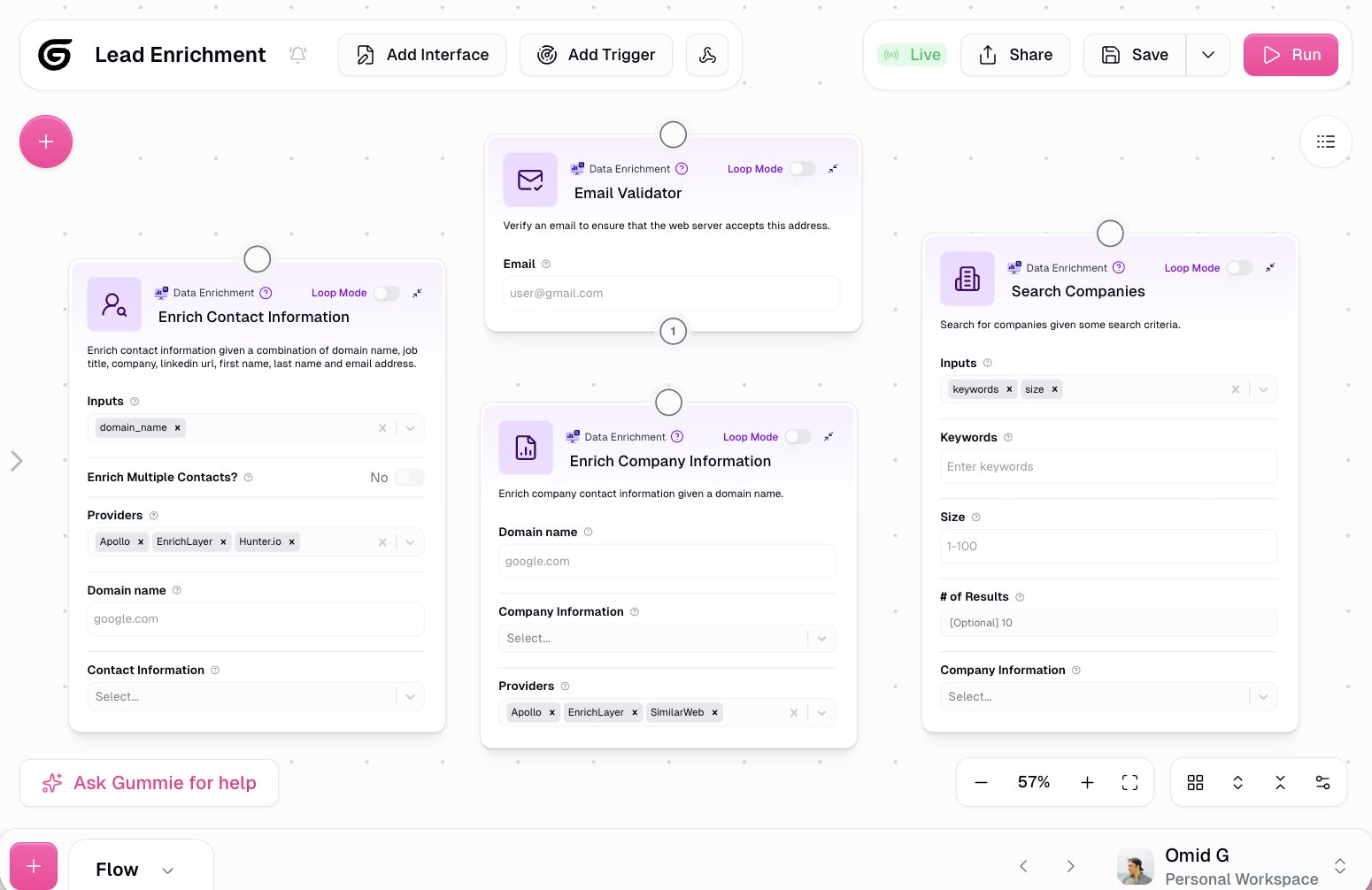
The platform also has two core features, Flows and Agents. Flows are your typical automated workflows where you drag nodes onto a canvas and connect them with conditional logic. Agents act more as autonomous coworkers that can figure out how to accomplish any task you give them. You just explain what you want the agent to do, connect it to the tools you want it to access, and it handles the rest.
For lead enrichment specifically, this means you can build a workflow that takes a list of raw leads, enriches them with data from multiple sources, scores them using an LLM, and then sends personalized outreach emails. And it can do this all in one workflow.
It's used by teams at Shopify, Instacart, and Webflow, but also by solo operators and agencies like myself. I've been a customer for over a year now, and they let me write these posts because I'm so involved in the AI and automation space.
Here are some things I like about Gumloop:
- Can integrate with Apollo, Enrich Layer, SimilarWeb, and pretty much any other enrichment tool through its MCP and app integrations
- Has built-in AI web scraping features so you can enrich leads with data from any website without needing a separate scraping tool
- You don't need your own LLM API keys to get started (but you can bring your own if you want)
- The Gummie AI assistant can help you build any enrichment workflow just by talking to it in natural language
- Has pre-built templates for lead enrichment and outreach workflows so you don't have to start from scratch
Here are some things that could be improved:
- It's not a data source itself, so you still need at least one enrichment provider feeding into it
- It's a full automation and AI agent platform, so if you only need basic enrichment and nothing else, it might feel like more than you need
- Because it can do so many things, it can sometimes be hard to know where to start
Overall, Gumloop is the tool I recommend if you're already using one or more enrichment sources and you want to actually automate the entire process. The real power comes when you take multiple data sources and you connect them together to complete a task. And that's exactly what Gumloop is built for.
Gumloop pricing

Here are Gumloop's pricing plans:
- Free: $0/month with 2,000 credits/month, 1 seat, 1 active trigger, Gummie agent, unlimited nodes and flows
- Solo: $37/month with 10,000+ credits/month, unlimited triggers, webhooks, email support, bring your own API key
- Team: $244/month with 60,000+ credits/month, 10 seats, unlimited workspaces, dedicated Slack support, team usage and analytics
- Enterprise: Custom pricing with role-based access control, SCIM/SAML support, admin dashboard, audit logs, virtual private cloud
You can learn more about what each plan includes on their pricing page.
Gumloop reviews
Here's what customers of Gumloop rate the tool on third-party websites:
- G2: 4.8 out of 5 star rating (from +6 user reviews)
- Product Hunt: 5 out of 5 star rating (from +9 user reviews)
Which lead enrichment tool is best?
For most teams, Apollo is the best place to start. It has one of the largest contact databases, the pricing is accessible, and it handles both enrichment and outbound in one platform. If you're in B2B sales, and you need accurate data with strong CRM integration, Apollo is good enough.
But if you’re a nerd like me, and you want to get the most out of the lead enrichment process, you don’t want to use just one source of data.
You can get really creative with it and do things like merge intent data from Enrich Layer, get demographics and company intelligence from SimilarWeb, run email verification, and then use a tool like Gumloop to automate the whole thing.
That's how you find new leads that actually convert, and run marketing campaigns at a scale that just wasn't possible a few years ago.
When I think back to my internship days manually pulling leads from LinkedIn one by one, it's wild how far these data enrichment tools have come. What used to take me an entire day now takes minutes. And the conversion rates are better because the data is better. So pick your stack, connect them together, and start building.

Read related articles
Check out more articles on the Gumloop blog.